How DMSO Heals Nerves and Eliminates Pain: Scientific Guide and Evidence Review (2026)
In This Article:
- 1. What is DMSO? The Medical Anomaly Explained
- 2. The Structural Mechanics: How DMSO Heals Damaged Nerves
- 3. Shifting the Gating Mechanism: How DMSO Eliminates Pain
- 4. Key Clinical Applications (Neuropathy, Sciatica, and Beyond)
- 5. The SEO Expert Protocol: How to Use DMSO Safely at Home
- 6. Frequently Asked Questions (FAQ)
1. What is DMSO? The Medical Anomaly Explained
Dimethyl Sulfoxide ($C_2H_6OS$) is a highly polar, water-miscible organic sulfur compound. Originally discovered in the late 19th century as a byproduct of the wood pulping process, its profound medical potential was realized in the 1960s by a team led by Dr. Stanley Jacob at the University of Oregon Medical School.
Dr. Jacob discovered that DMSO possessed an unparalleled ability to rapidly penetrate intact biological membranes—such as human skin—without causing structural damage. While passing through tissues, DMSO acts as a universal solvent and molecular carrier, drawing other therapeutic compounds directly along with it into the deep underlying tissues and bloodstream.
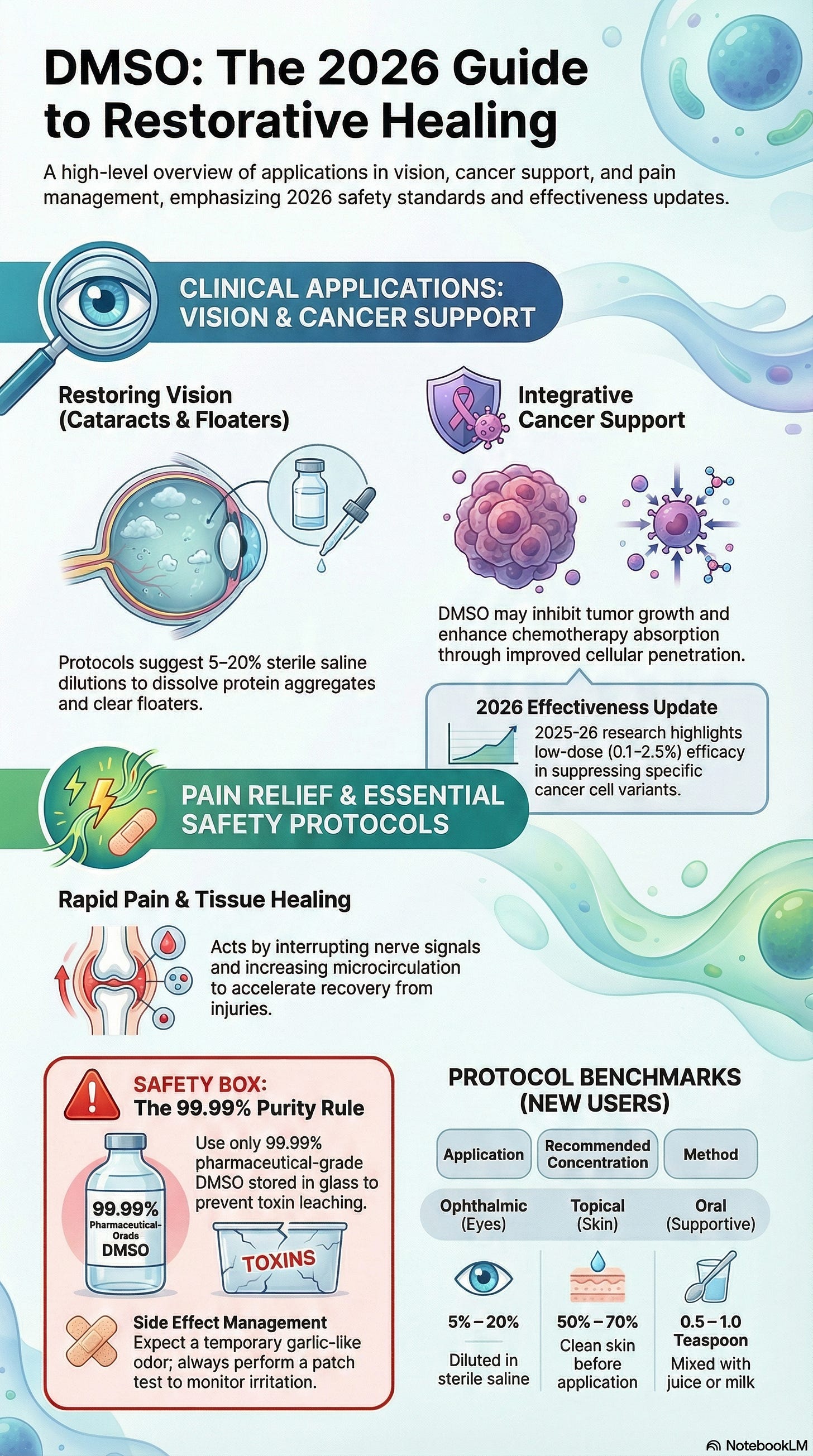
Despite decades of political and regulatory controversy within western medical institutions, DMSO remains an FDA-approved treatment for interstitial cystitis (a painful, chronic bladder inflammatory disease) and is widely used across Europe, Asia, and global veterinary medicine for structural and neurological recovery.
2. The Structural Mechanics: How DMSO Heals Damaged Nerves
When a peripheral nerve is compressed, severed, or starved of oxygen due to systemic conditions like diabetes, a cascade of localized degradation begins. Nerves possess a delicate internal architecture reliant on microcirculation and axonal transport. DMSO targets this degeneration through several distinct physiological mechanisms:
A. Reversal of Localized Ischemia and Edema
When tissue is traumatized, fluid pools around the nerve sheath, exerting physical pressure that cuts off the nerve's blood supply (microvascular ischemia). If blood flow is not restored, cellular starvation and permanent neuropathy result.
DMSO is an exceptionally potent vasodilator. Upon application, it induces the release of local histamine and stimulates prostaglandin synthesis, expanding micro-capillaries. Simultaneously, its hyper-osmotic characteristics draw excess interstitial fluid away from the injury site, instantly decreasing edema. By restoring oxygenated blood to the oxygen-starved nerve, it prevents neural necrosis and jumpstarts cellular repair.
B. Stabilization of Cell Membranes
Injured cells suffer from leaky membranes, allowing an influx of toxic levels of extracellular calcium, which triggers apoptosis (programmed cell death). DMSO acts as a biological stabilizer. It embeds itself within the phospholipid bilayer, reinforcing cellular integrity, preserving intracellular potassium, and normalizing membrane permeability. This stabilization keeps damaged nerve cells alive long enough for autonomous regeneration to take place.
C. Acceleration of Axonal Transport
Healthy nerves rely on microtubule highways to ship nutrients, structural proteins, and neurotransmitters from the nerve body down the axon. Inflammation completely breaks down this transit system. Research indicates that DMSO preserves and repairs microtubule assembly, optimizing axonal transport even in environments of elevated oxidative stress.
3. Shifting the Gating Mechanism: How DMSO Eliminates Pain
Beyond physically healing the cellular structure of nerves over time, DMSO exhibits an immediate, profound analgesic (pain-relieving) effect. It does not numb the area like a local anesthetic (such as lidocaine), nor does it artificially block brain receptors like an opioid. Instead, it alters peripheral sensory nerve transmission.
The C-Fiber Conduction Block
Pain signals travel to your central nervous system via distinct pathways. Acute, sharp pain travels along myelinated A-delta fibers. Chronic, agonizing, burning, and deep throbbing pain signals are carried primarily by unmyelinated, slow-conducting C-type nerve fibers.
In a landmark study published in Neuroscience Letters, researchers evaluated the direct effects of DMSO on peripheral nerve C-fibers. The findings were monumental:
- Even at incredibly low concentrations (5% to 7%), DMSO significantly slowed down conduction velocity in C-fibers.
- At concentrations of 9% or higher, DMSO caused a total, complete block of C-fiber conduction.
- The onset of this nerve conduction block was almost immediate when concentrations of 15% or higher were utilized.
Crucially, this nerve block is entirely safe and fully reversible. Unlike chemical neurolytic agents that permanently destroy nerve pathways, when DMSO is metabolized and exits the tissues, normal, healthy sensory function returns entirely intact, completely free of structural damage.
4. Key Clinical Applications (Neuropathy, Sciatica, and Beyond)
Because of its multi-faceted properties as a membrane stabilizer, anti-inflammatory agent, and C-fiber blocker, DMSO has demonstrated profound therapeutic success across a variety of clinical conditions:
| Condition | Primary Action of DMSO |
|---|---|
| Diabetic & Peripheral Neuropathy | Restores capillary microcirculation to dying nerve endings; dampens burning sensations. |
| Sciatica & Radiculopathy | Penetrates deep into muscle layers to relieve nerve root compression and inflammation. |
| Complex Regional Pain Syndrome (CRPS) | Clinical trials confirm that a 50% topical DMSO cream systematically reduces agonizing pain and hyperalgesia. |
| Shingles & Post-Herpetic Neuralgia | Flushes out viral neuro-inflammation and immediately blunts the intense neuropathic fires. |
5. How to Use DMSO Safely at Home
Because DMSO is an exceptionally powerful compound capable of transdermal transport, using it safely requires a strict adherence to chemical protocols. If you use it incorrectly, you risk driving unwanted toxins, surface chemicals, or synthetic compounds straight through your skin and directly into your bloodstream.
Step-by-Step Topical Application Protocol
- Meticulous Skin Preparation: Thoroughly wash the targeted skin area with warm water and organic, fragrance-free soap. Rinse completely. Ensure no lotions, synthetic fragrances, sunscreens, or chemical residues remain on the skin, as DMSO will drag them deep inside your body.
- Dilute Accurately: Pure 99.9% DMSO applied directly to the skin can cause localized chemical irritation, severe burning, or superficial blistering. For optimal therapeutic results with minimized skin reaction, dilute the liquid down to a 50% to 70% concentration using pure distilled water or organic, cold-pressed aloe vera gel.
- Application Method: Clean your hands or utilize a sterile cotton ball/glass dropper to apply a thin layer of the solution over the painful area. Do not forcefully massage or rub it aggressively into the skin—simply paint it on smoothly.
- The Drying Window: Leave the area completely uncovered and exposed to the air for 20 to 30 minutes. Do not put clothing or bandages over the area until it is fully, 100% dry to the touch.
Common, Expected Side Effects
- The Garlic Sensation: Within minutes of topical application, you will notice a distinct, garlic-like or oyster-like taste in your mouth and a corresponding body odor. This occurs because DMSO is metabolized into dimethyl sulfide (DMS), which is excreted through your breath and skin pores. It is completely harmless.
- Transient Dermatitis: Mild skin redness, local itching, and a warm, prickling sensation are completely normal reactions. This typically fades within an hour.
6. Frequently Asked Questions (FAQ)
Q: How long does it take for DMSO to stop nerve pain?
A: Because DMSO acts via a direct electrochemical conduction block on peripheral C-fibers, topical pain relief is often noticed within 5 to 20 minutes of application. For structural healing of chronic, long-term neuropathies, consistent application for 4 to 6 weeks may be required to completely downregulate cellular inflammation.
Q: Can I wear nitrile gloves when applying DMSO?
A: No. Standard thin medical nitrile and latex gloves are instantly dissolved and penetrated by DMSO. If you wear them, the dissolved plastics will be driven directly into your skin. Use bare, clean hands, a sterile glass dropper, or heavy chemical-resistant butyl rubber gloves if protection is necessary.
Q: Why does my DMSO bottle freeze or turn solid at room temperature?
A: Pure 99.9% Pharmaceutical Grade DMSO has a uniquely high freezing point of 64°F (17.8°C). If your storage room dips slightly below standard temperature, it will crystallize into solid ice-like structures. This is an excellent sign of extreme chemical purity. To thaw it safely, place the sealed glass jar into a bowl of warm tap water for a few hours.
Conclusion: A Paradigm Shift in Pain Management
Dimethyl Sulfoxide is far more than a simple home remedy; it is a bio-chemical powerhouse that fundamentally addresses the underlying drivers of chronic neuro-inflammation and chronic nerve-related pain signaling. By working through the vascular, antioxidant, and electrochemical pathways of the nervous system, DMSO allows individuals to step out of the cycle of symptom-masking drugs and embrace a true mechanism of cellular restoration. Always consult a knowledgeable integrative healthcare specialist before modifying your health protocols, and always maintain rigorous sanitation habits when handling this powerful therapeutic solvent.Primary Source for This Review
- A Midwestern Doctor - How DMSO Heals The Nerves & Eliminates Pain (June 2026)
.png)
.png)

.png)

.png)


Comments
Post a Comment