DMSO Safety Guidelines (2026): Grade, Routes, Side Effects, and What the FDA Actually Allows
By OneDayMD | Updated September 2026 | Editorial synthesis of FDA labeling, hospital cryoprotectant limits, and published human safety data
- DMSO itself is a low-acute-toxicity solvent. The usual danger is grade, concentration, route, and what rides in with it.
- The only official human dosing schedule on a US label is 50 mL of 50% DMSO in the bladder for 15 minutes.
- Transplant teams cap intravenous DMSO at about 1 g/kg per day and keep the infusion dilute. Concentrated IV DMSO has caused hemolysis.
- A 2019 review of 109 human studies found mostly mild, dose-related skin and gut reactions. Small doses looked comparatively safe; high doses did not.
- No respiratory-society guideline supports home nebulizing for COPD, asthma, or fibrosis. That use is an experiment, not a safety standard.
Viral posts now treat DMSO as a kitchen-cupboard lung tonic. That claim sits next to a much thinner official record. This guide collects the actual safety constraints — FDA labeling, hospital infusion limits, grade rules, and published adverse-effect data — so readers can separate a solvent’s toxicology from a social-media protocol.
Related OneDayMD reading: DMSO for COPD, asthma, and lung recovery · DMSO 101 · Systematic review of DMSO.
Table of contents
- What “guidelines” actually exist
- FDA and approved uses
- Pharmaceutical vs industrial grade
- How toxic is DMSO itself?
- Side effects by route
- IV and stem-cell dose caps
- Inhaled and nebulized use
- Who should avoid it
- Drug interactions and the carrier effect
- Monitoring if it is used medically
- Practical safety rules
- FAQ
What is DMSO?
DMSO stands for DiMethyl SulfOxide — an organic sulfur compound derived as a byproduct of wood pulp processing. DMSO (Dimethyl Sulfoxide), a naturally occurring compound with decades of research behind its use as an anti-inflammatory, analgesic, and cellular-protective agent.
FDA-approved for interstitial cystitis, it has been used off-label by athletes, physicians, and patients for musculoskeletal injuries, chronic pain, wound healing, and more.
What “guidelines” actually exist
There is no official consumer monograph titled “How to use DMSO at home for lungs, pain, or detox.” What exists is a stack of narrower documents:
- Rimso-50 prescribing information — the only US human drug label for DMSO as an active ingredient.
- Transplant society practice — EBMT, AABB, and related groups cap DMSO in thawed cell products at about 1 g/kg (≈ 1 mL/kg) per day.
- Occupational toxicology dossiers — high oral and dermal LD50 values, low carcinogenicity concern, irritation and odor as the dominant workplace effects.
- A 2019 systematic review of 109 human studies — the best single map of adverse reactions by route and dose.
Internet “protocols” that specify tablespoons by mouth, 70% chest rubs, or nebulizer drops are not in that stack. They are off-label improvisation.
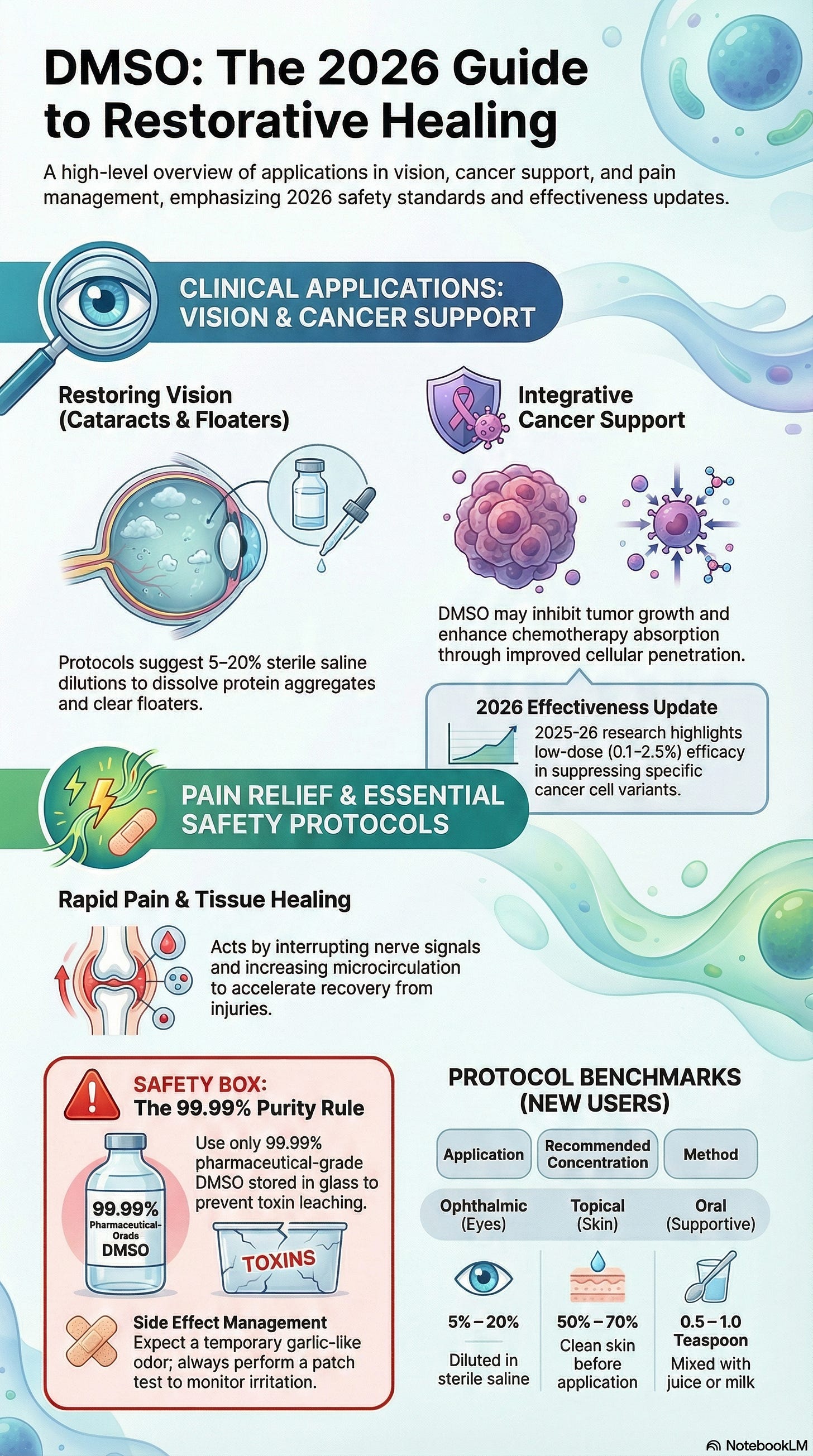
FDA and approved uses
Rimso-50 is a sterile, non-pyrogenic 50% w/w DMSO aqueous solution. The labeled use is symptomatic relief of interstitial cystitis. The same label states it has not been approved as safe or effective for any other indication, and it is not for intramuscular or intravenous injection.
Labeled technique:
- Instill 50 mL into the bladder by catheter or syringe.
- Dwell 15 minutes, then void.
- Repeat about every two weeks until relief, then space the interval.
- Very sensitive bladders may need anesthesia for the first sessions.
DMSO also appears in medicine as an excipient, not as a lung drug:
- Vehicle in some topical diclofenac products (Pennsaid family) for knee osteoarthritis.
- Cryoprotectant in hematopoietic stem-cell and some gene-therapy products, usually at about 5–10% in the frozen bag, with a hard cap on how much DMSO the patient may receive.
- Veterinary topical use for swelling in horses and dogs — a different regulatory lane from human self-treatment.
OTC jugs sold as “solvent” or “supplement” are not FDA-approved drugs. Mayo Clinic–style consumer references still warn that industrial and veterinary bottles must not be used in people because purity is unknown.
Pharmaceutical vs industrial grade
This is the first safety rule that viral posts skip. DMSO is a membrane-crossing solvent. Whatever is dissolved in the bottle becomes a systemic dose.
| Grade | Typical specification | Human skin, mucosa, or lung? |
|---|---|---|
| Industrial / technical | ~99.0–99.5% solvent grade; water, color, residual DMS less tightly controlled | No. Process impurities are not specified for people. |
| ACS reagent | Lab chemistry | Not a medical product. |
| USP / Ph. Eur. pharmaceutical | ≥99.9% with a compendial impurity panel; ask for a batch COA | The only grade that belongs in a medical discussion. |
| Sterile injectable / Rimso | Sterile, non-pyrogenic, labeled concentration | Required for bladder or any parenteral use. A USP bottle on a shelf is not automatically sterile. |
“99.9%” on a marketplace listing is not the same as USP manufactured under GMP. Trace thiochemicals (dimethyl sulfide, dimethyl disulfide) also worsen the garlic odor that people blame on “toxins leaving the body.” That odor is mostly metabolism of DMSO to dimethyl sulfide. Dirty product can add its own smell on top.
Skin-prep rule: wash the site. DMSO will carry nicotine film, lotion, essential oils, and pesticide residue inward with it.
How toxic is DMSO itself?
Acute mammalian toxicity is low compared with many industrial solvents:
- Oral LD50, rat: roughly 15–28 g/kg
- Dermal LD50, rat: greater than 40 g/kg
- Inhalation: high LC50 in short rat tests; not a high-lethality vapor at ordinary workplace levels
It is not listed as a human carcinogen by IARC, NTP, or OSHA. Residual DMSO in finished drugs is treated as an ICH Q3C Class 3 solvent (low toxic potential).
Low acute lethality is not a license for any concentration in an alveolus. Toxicity is route- and concentration-dependent. Cell work often cited for “anti-inflammatory DMSO” also shows monocyte death near 2% — immediately above the window people advertise as therapeutic.
Side effects by route
Madsen et al. (2019) reviewed 109 human studies. Most reactions were transient. Dose mattered: lower exposures produced few or mild events; higher exposures drove more gastrointestinal, skin, and cardiovascular reactions.
Almost universal
- Garlic or oyster taste within minutes
- Breath and skin odor for up to 72 hours (dimethyl sulfide, not “proof it is working”)
Topical
Burning, redness, itching, hives, dryness or scaling, contact dermatitis, and blistering at high percentages. After systemic absorption: headache, sedation, dizziness, nausea. In one older 80% gel study at 1 g/kg/day, sedation was reported in about half of subjects, headache in about 40%, nausea in about a third.
Intravesical (Rimso-50)
Bladder pain or spasm, transient chemical cystitis, garlic odor. Rare systemic dermatitis or anaphylactoid reaction. The label also flags histamine release.
Intravenous / thawed cell products
Histamine-type infusion reactions: nausea, vomiting, flushing, blood-pressure swings, bradycardia, cough, dyspnea, headache. Uncommon but documented: arrhythmia, encephalopathy, seizure, anaphylaxis. These are why hospitals premedicate and limit the daily DMSO load.
IV and stem-cell dose caps
Rimso-50 is explicitly not for IV or IM use. The intravenous DMSO that hospitals do give is a dilute cryoprotectant inside a cell product, not a wellness drip.
Practice limits that function as de facto guidelines:
- About 1 g DMSO per kg body weight per day (roughly 10 mL/kg of a 10% frozen product).
- Keep the concentration in the vein low. Hemolysis, hemoglobinuria, and prolonged bleeding time were reported with ~40% IV solutions and not when the same program dropped to ~10%.
- Some newer gene-therapy labels also cap total DMSO volume relative to estimated plasma volume and warn about hypersensitivity from the DMSO excipient.
Home intravenous DMSO sits outside every document in this list.
Inhaled and nebulized use
This is the gap the current viral COPD thread jumps over.
No FDA-approved inhaled DMSO product. No GOLD, GINA, or ATS/ERS recommendation.
What the literature actually contains:
- Experimental sheep work from the 1980s using nebulized DMSO plus heparin after smoke inhalation — a lab model, not a home COPD protocol.
- Rodent vehicle studies in which repeated airway delivery of 2–10% DMSO raised some inflammatory markers.
- Occupational notes that aerosol can be absorbed, and that concentrated DMSO vapor is not the same thing as a 1% aqueous mist.
Even writers who promote inhaled DMSO generally warn that high-concentration vapor onto alveoli can disturb surfactant. Mixing DMSO in a consumer nebulizer with hydrogen peroxide, chlorine dioxide, or colloidal silver is a second, untested experiment on top of the first.
If someone with oxygen-dependent COPD wants to discuss DMSO at all, the safety-first frame is: pharmaceutical grade, a clinician who will keep repeating spirometry and saturation checks, and do not abandon oxygen, long-acting bronchodilators, pulmonary rehab, or transplant evaluation because a thread used the word “cured.”
For the evidence — and the overstatement — behind the 2026 social-media lung claims, see our related discussion of the Midwestern Doctor thread and the 2022 zinc-iodide–DMSO case series (8 asthma patients, 7 COPD patients, no control group, combination product, not DMSO alone).
Who should avoid it
| Situation | Why it is on the caution list |
|---|---|
| Pregnancy | High-dose intraperitoneal animal studies were teratogenic. Oral/topical animal data are mixed. Human data are inadequate. Label: use only if benefit outweighs risk. Most clinicians treat as avoid. |
| Breastfeeding | Excretion in milk unknown. Label: caution. |
| Children | Safety and effectiveness not established on the Rimso label. |
| Known DMSO allergy | Histamine release; rare anaphylactoid reactions. |
| Urinary tract malignancy | Label warns that vasodilation may be harmful. |
| Severe liver or kidney disease | Label requires periodic LFTs, renal tests, and CBC during medical use. |
| Anticoagulants, steroids, sedatives, other topicals on the same skin | Potentiation and increased absorption. Sulindac is a specifically cited poor combination in secondary references. |
Chronic medical use also triggers the label’s eye monitoring recommendation. High-dose animal work produced lens changes. That 1960s finding helped freeze US research. Careful human follow-up has not clearly reproduced a clinical cataract signal at medical doses, but slit-lamp exams remain on the official label.
Drug interactions and the carrier effect
The Rimso label is blunt: some data indicate DMSO potentiates concomitantly administered medicines. That is the same property people like — it walks other molecules through skin and membranes.
Practical implications:
- Topical steroids or NSAIDs on the same patch of skin can be absorbed in larger amounts.
- Systemic effects of anticoagulants and sedatives may increase.
- Anything still on the skin — including “natural” oils — is now part of the dose.
The carrier effect is why industrial grade is not a bargain. You are not only dosing DMSO. You are dosing the unspecified remainder of the drum.
Monitoring if it is used medically
Copied from the only US human label, and still a reasonable checklist for any supervised chronic course:
- Full eye evaluation including slit lamp before treatment and periodically
- About every six months: CBC, liver function, renal function
- Stop and treat immediately for anaphylactoid symptoms
- Reconcile the full medication list before each exposure
Practical safety rules that are actually grounded
- Pharmaceutical grade only. Ask for a batch certificate of analysis. Never industrial, paint-stripper, or unlabeled solvent.
- Sterile product for any bladder or parenteral use. USP on a retail shelf is not an IV bag.
- Respect the hospital IV cap if DMSO is ever given into a vein: dilute solution, on the order of ≤1 g/kg/day, with monitoring. Do not improvise this at home.
- Clean, intact skin if the route is topical. No other chemicals on the site.
- Do not treat odor as efficacy. Dimethyl sulfide on the breath is pharmacokinetics.
- Do not stop indicated cardiopulmonary therapy to run an uncontrolled n=1.
- No guideline supports home nebulization, especially mixed with oxidizers.
- Stop for spreading rash, wheeze, facial swelling, severe dizziness, visual change, or worsening dyspnea.
FAQ
Is DMSO safe if it is “natural”?
DMSO occurs in small amounts in some foods and is a wood-pulp derivative. “Natural” does not set a lung dose. Safety is a function of grade, concentration, route, and co-administered chemicals.
Does the garlic smell mean the product is contaminated?
Usually no. The body reduces some DMSO to dimethyl sulfide, which leaves through breath and skin for up to 72 hours. Contaminated industrial product can smell worse, which is a separate reason not to use it.
Can DMSO cure stage 4 COPD?
That is not an FDA-labeled claim and it is not established by randomized trials. A 2022 paper often cited online used oral zinc iodide plus 30% DMSO in 8 asthma and 7 COPD patients, with no control group. The authors called the report anecdotal and asked for a proper trial. Testimonials are not spirometry.
What is a “safe” topical percentage?
There is no consumer monograph. Approved Pennsaid uses a high DMSO percentage as a vehicle for diclofenac, under a drug label. Undiluted 90–99% on intact skin commonly burns. Higher percentage means more local injury and more systemic absorption — not automatically more benefit.
Is MSM the same thing?
No. MSM (methylsulfonylmethane) is an oxidation product of DMSO. It does not carry other chemicals through skin the way DMSO does. Do not swap safety assumptions between the two.
Related OneDayMD DMSO guides
- DMSO 101: Benefits, uses, dosage and side effects
- Systematic review of DMSO: efficacy, safety, applications
- DMSO for Long COVID: 2025 Protocol That’s Helping Thousands Recover
- DMSO Could Save Millions From Brain and Spinal Injury
- DMSO for COPD, asthma, and lung recovery
- A woman facing a lung transplant reversed her condition with DMSO
- DMSO and the eyes: complete guide (organized by category)
- DMSO: A Versatile Compound for Eye Health and Vision Restoration
- DMSO and Castor Oil Eye Drops for Cataracts, Macular Degeneration, Floaters, Vision
Comments
Post a Comment