DMSO for Blood Vessels, Clots and Stroke: Evidence, Mechanisms, Safety and Clinical Limitations (2026)
Dimethyl sulfoxide (DMSO) is one of the more unusual compounds in medicine. It has anti-inflammatory, analgesic, membrane-active, antioxidant and drug-delivery properties, and decades of laboratory research have examined its effects on platelets, vascular tone, ischemia, tissue injury and the blood-brain barrier.
These properties have generated a provocative hypothesis: could DMSO improve circulation, reduce vascular injury and protect tissue during ischemic events such as stroke?
The hypothesis is biologically plausible, but the clinical evidence is much less definitive than some popular accounts suggest. DMSO has demonstrated important vascular and neuroprotective effects in laboratory and experimental models, while human evidence remains limited and insufficient to establish DMSO as a standard treatment for acute stroke, myocardial infarction, deep-vein thrombosis or peripheral arterial disease.
Abstract
DMSO has been studied for decades because it possesses a combination of biological properties that may influence vascular function. Experimental studies have reported antiplatelet effects, vasorelaxation, antioxidant activity, modulation of inflammatory pathways, protection against ischemia-reperfusion injury and effects on the blood-brain barrier. DMSO is also an established pharmaceutical penetration enhancer and has a recognized clinical role in intravesical treatment of interstitial cystitis.
However, biological plausibility should not be confused with clinical efficacy. The clinical stroke literature is sparse. A preliminary clinical study of DMSO combined with fructose-1,6-diphosphate included only 11 treated patients and 5 controls. Although the investigators reported apparent benefit and tolerability, the study was small and exploratory. Conversely, other experimental studies have produced negative findings, demonstrating that DMSO does not consistently prevent ischemic damage in every model.
The most defensible interpretation is therefore that DMSO has a credible scientific rationale for further vascular and neuroprotective research, but its effectiveness for major human vascular diseases remains unproven.
1. Why DMSO Is Scientifically Interesting
DMSO is a small sulfur-containing molecule with unusual physicochemical properties. It interacts with biological membranes, water, proteins and numerous pharmacological compounds. One of its most established pharmaceutical functions is as a penetration enhancer, increasing the movement of some drugs through the skin.
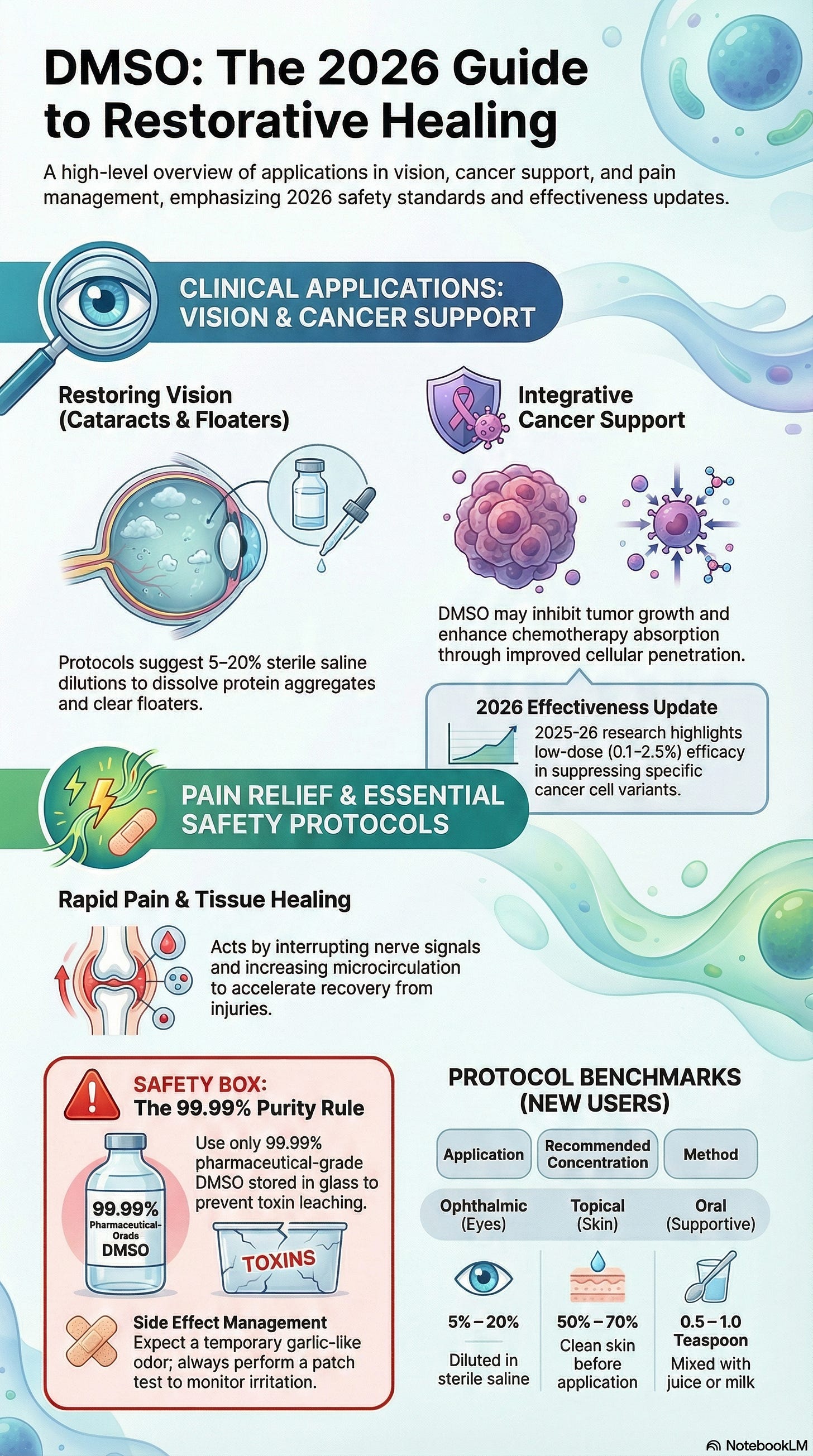
This property matters because DMSO is not simply an inert carrier. Depending on concentration and experimental conditions, it can influence cellular membranes, inflammatory signaling, oxidative stress and vascular responses.
That combination makes DMSO interesting for ischemic injury, where multiple processes occur simultaneously:
- loss of blood flow
- platelet activation and thrombosis
- oxidative stress
- inflammation
- endothelial dysfunction
- blood-brain barrier disruption
- cellular energy failure
- ischemia-reperfusion injury
A compound that affects several of these pathways could theoretically have value beyond conventional approaches that primarily target one mechanism.
2. DMSO and Platelets
One of the most reproducible areas of DMSO research concerns platelet biology.
Experimental studies have found that DMSO can inhibit platelet aggregation and interfere with several platelet-activation pathways. The magnitude of these effects depends strongly on concentration and exposure conditions.
This is potentially important because platelet activation contributes to arterial thrombosis, including the thrombotic component of ischemic stroke and myocardial infarction.
But an important distinction must be maintained:
Inhibiting platelet aggregation in an experimental system is not equivalent to proving that DMSO safely treats arterial thrombosis in patients.
Established antiplatelet and anticoagulant therapies have been evaluated in large controlled clinical trials, with clearly defined indications, doses, contraindications and monitoring requirements. DMSO has not undergone comparable evidence development for these indications.
3. DMSO and Blood-Vessel Relaxation
Experimental vascular studies suggest that DMSO can produce vasorelaxation. Some of this activity appears to involve endothelial nitric-oxide signaling and the nitric oxide/cGMP pathway.
This is biologically interesting because endothelial dysfunction and impaired nitric-oxide signaling are central features of many cardiovascular disorders.
However, a laboratory demonstration of vascular relaxation does not automatically translate into meaningful increases in blood flow in a human artery or improved outcomes in patients with cardiovascular disease.
The relevant clinical questions remain unanswered:
- Does DMSO produce a clinically meaningful increase in tissue perfusion?
- At what dose?
- By which route?
- For how long?
- In which patients?
- What is the bleeding risk?
- How does it interact with standard antithrombotic therapy?
These questions require prospective human trials.
4. DMSO and the Endothelium
The vascular endothelium is more than a passive lining. It regulates vascular tone, permeability, inflammation and thrombosis.
Experimental work suggests that DMSO can influence endothelial and inflammatory pathways and may reduce some forms of oxidative and ischemic injury.
This is particularly relevant to ischemia-reperfusion injury. Restoration of blood flow is essential, but reperfusion can itself generate oxidative and inflammatory injury. Experimental research has therefore examined whether DMSO can provide cytoprotection during this process.
Again, the distinction between vascular protection in experimental models and clinical vascular healing in humans is critical.
5. DMSO and Ischemic Stroke
Stroke is the most clinically important area discussed in relation to DMSO, but it is also where careful evidence grading is most necessary.
Older experimental research proposed that DMSO might influence several components of cerebral ischemia, including platelet behavior, oxidative injury, edema and vascular function. A number of animal experiments subsequently reported potentially protective effects.
There are also studies pointing in the opposite direction. In one experimental middle cerebral artery occlusion model, intravenous DMSO did not prevent the development of ischemic edema, neuronal injury or blood-brain barrier changes.
A small preliminary human study investigated DMSO combined with fructose-1,6-diphosphate in patients with ischemic stroke. Eleven patients received the combination and five received standard therapy. The investigators reported better neurological outcomes in the treatment group, but the study was far too small to establish efficacy or change clinical practice.
An earlier review argued that DMSO deserved formal clinical trials in cerebral and extracerebral ischemia. That conclusion is important historically because it demonstrates that the hypothesis has been around for decades, but it is not equivalent to demonstrating that the treatment works.
6. What Has Changed in Stroke Medicine?
The standard treatment landscape has also evolved substantially since many of the early DMSO studies were conducted.
The 2026 American Heart Association/American Stroke Association guideline recommends rapid stroke-system evaluation and emphasizes evidence-based reperfusion treatment. Eligible patients with acute ischemic stroke can receive intravenous thrombolysis with either alteplase or tenecteplase within the appropriate treatment window, including selected patients in extended windows using advanced imaging. Endovascular thrombectomy is established treatment for appropriate large-vessel occlusions and has expanded to additional patient groups.
Therefore, DMSO should not be presented as a therapy that patients can use instead of modern stroke treatment.
7. Could DMSO Be a Neuroprotective Agent?
This remains one of the more interesting research questions.
Experimental studies have reported that DMSO can influence oxidative stress, excitotoxicity, inflammatory signaling, cerebral edema and blood-brain barrier integrity. Other animal work has suggested potential effects on chronic cerebral hypoperfusion and neuronal injury.
These findings fit a broader modern stroke concept: reperfusion restores blood flow, while adjunctive neuroprotection might theoretically reduce the amount of tissue that is ultimately lost.
Unfortunately, neuroprotection has proved difficult to translate from animal models to humans. Reviews of stroke neuroprotection have emphasized that many apparently promising agents have failed to produce definitive clinical benefit.
DMSO therefore belongs in the category of interesting translational research, not established stroke therapy.
8. DMSO and Heart Disease
DMSO has also been studied in experimental cardiac ischemia and oxidative injury. Research has reported effects on cardiac-cell viability, oxidative stress, membrane integrity and ischemia-reperfusion mechanisms.
These findings are biologically plausible because the heart is highly sensitive to both ischemia and reperfusion-associated oxidative stress.
But there is currently insufficient clinical evidence to conclude that DMSO improves outcomes in acute myocardial infarction or should be used as a replacement for established emergency reperfusion and antithrombotic strategies.
9. DMSO and Peripheral Vascular Disorders
The peripheral vascular literature is heterogeneous.
DMSO has been investigated or used in various topical formulations involving venous disease, superficial thrombophlebitis, wounds, inflammatory conditions and local vascular symptoms. Its role is often combined with another active drug, making it difficult to determine how much of the observed effect comes from DMSO itself.
This is an important methodological problem. A preparation containing DMSO + heparin, for example, should not automatically be interpreted as evidence that DMSO alone dissolves thrombi.
Likewise, improvement in pain, redness or swelling does not prove that a DVT has resolved.
Objective confirmation with appropriate imaging is necessary when thrombosis is suspected.
10. DMSO and Wound Healing
DMSO has attracted interest in chronic wounds because of its anti-inflammatory, penetration-enhancing and tissue-protective properties. Experimental and clinical literature has investigated DMSO-containing formulations in ulcers, inflammatory wounds and other peripheral tissue disorders.
However, wound healing has many determinants, including:
- arterial blood supply
- venous drainage
- blood glucose control
- infection
- pressure and mechanical stress
- nutrition
- smoking
- edema
- underlying vascular disease
A wound that improves after a DMSO-containing product cannot automatically establish that DMSO corrected the underlying vascular disease.
11. Raynaud Phenomenon and Cold Extremities
Because DMSO can affect vascular tone and local inflammatory responses, its potential role in Raynaud phenomenon and cold extremities is biologically interesting.
However, the evidence here should be regarded as exploratory. Improvements in warmth or skin color are clinically interesting observations but are not sufficient to establish disease modification.
12. Testimonials: Interesting Signals, Weak Evidence
A large collection of patient reports can be useful for hypothesis generation.
For DMSO, anecdotal reports include claims involving pain, cold extremities, venous symptoms, wounds and neurological conditions. These stories may help identify phenomena worthy of formal study.
But testimonials have major limitations:
- there may be no objective diagnosis
- there is usually no untreated comparison group
- other therapies may have been used simultaneously
- natural recovery can be mistaken for treatment effect
- selective reporting favors dramatic successes
- adverse outcomes may be underreported
Testimonials therefore belong at the bottom of an evidence hierarchy. They should not be presented as equivalent to randomized controlled trials.
13. DMSO Is Not Always Pharmacologically Inert
One of the most important practical characteristics of DMSO is its ability to modify transdermal drug delivery.
DMSO is a well-established penetration enhancer and has been studied for delivery of both hydrophilic and lipophilic compounds through the skin.
This means that mixing DMSO with another compound can potentially change the amount of that compound reaching tissue and the circulation.
The implication is straightforward:
Do not assume that adding DMSO to a topical medicine leaves the medicine's pharmacology unchanged.
A 2026 review of topical drug application likewise emphasized that vehicle interactions and changes to skin-barrier properties can materially alter percutaneous absorption.
14. Safety and Adverse Effects
DMSO should not be described as risk-free.
A systematic review of adverse reactions in humans documented a range of reported adverse effects, with many being related to concentration, route and formulation.
Intravesical DMSO products, for example, can cause a garlic-like taste and odor and transient chemical cystitis; these effects are explicitly recognized in the product labeling.
Route matters enormously. Evidence supporting one form of DMSO cannot automatically be extrapolated to oral, intravenous, intramuscular, ophthalmic or high-concentration topical administration.
The same principle applies to pharmaceutical grade versus industrial products. Purity, contaminants, formulation and manufacturing standards matter when a substance is being considered for human use.
15. What Is DMSO Actually Approved For?
In the United States, DMSO has an established pharmaceutical indication for the symptomatic treatment of interstitial cystitis through intravesical administration. The FDA's 2026 generic-drug listings continue to identify dimethyl sulfoxide products for this indication.
This should not be confused with approval for treating stroke, DVT, myocardial infarction, peripheral arterial disease, brain injury or cancer.
16. Evidence-Grading Framework
| Evidence area | Current assessment |
|---|---|
| Platelet effects | Strong experimental evidence; insufficient evidence for clinical replacement of antiplatelet therapy |
| Vasorelaxation | Supported experimentally; clinical significance uncertain |
| Antioxidant/cytoprotective effects | Substantial preclinical literature |
| Ischemic stroke | Preclinical rationale plus limited human evidence; not established therapy |
| Myocardial ischemia | Primarily experimental |
| DVT treatment | Insufficient evidence for DMSO monotherapy |
| Peripheral vascular disease | Heterogeneous and largely low-level evidence |
| Drug penetration enhancer | Well established pharmacological property |
| Interstitial cystitis | Established U.S. medical indication |
17. The Most Important Research Question
The strongest case for DMSO today is not that its efficacy has already been proven.
The strongest case is that DMSO has enough biological activity and historical evidence to justify better clinical research than it has received.
A modern trial could test DMSO as an adjunct—not a replacement—to established reperfusion therapy.
For ischemic stroke, a rational research design would compare standard-of-care treatment against standard-of-care treatment plus a rigorously characterized DMSO formulation, with predefined outcomes such as:
- 90-day modified Rankin Scale
- infarct volume
- reperfusion measures
- symptomatic intracranial hemorrhage
- mortality
- functional independence
- serious adverse events
That would finally answer the question that decades of laboratory studies and anecdotes cannot answer:
Does DMSO improve clinically meaningful outcomes in patients?
18. Conclusion
DMSO deserves more scientific attention, but it does not deserve exaggerated certainty.
Its effects on platelets, vascular tone, oxidative stress, inflammation, tissue protection and drug transport provide a legitimate scientific rationale for investigation. Experimental stroke and ischemia studies suggest potentially useful mechanisms, and a small preliminary human stroke study provides a signal worth revisiting.
At the same time, the evidence is not strong enough to conclude that DMSO “heals blood vessels,” dissolves clinically important thrombi, reverses acute stroke, prevents millions of stroke deaths or should replace established cardiovascular and stroke therapies.
The most scientifically responsible position is therefore neither dismissal nor advocacy:
Until those trials exist, DMSO should be presented as a promising research candidate rather than an established treatment for acute vascular disease.
Medical Disclaimer
This article is an evidence review and is not a substitute for medical diagnosis or emergency treatment. Suspected stroke, myocardial infarction, pulmonary embolism, acute limb ischemia and other major vascular emergencies require immediate medical evaluation. Do not delay established treatment in order to self-administer DMSO.
Sources and References
From OneDayMD
- DMSO for Chronic Pain and Musculoskeletal Injuries: A Miraculous Therapy?
- DMSO Eye Drops: Complete Guide to Healing Cataracts, Macular Degeneration, Floaters & Glaucoma
- DMSO: A Versatile Compound for Eye Health and Vision Restoration
- DMSO for Stroke, Brain Injury, Spinal Cord Trauma, and Ischemic Damage
- DMSO 101: Benefits, Uses, Dosage and Side Effects
- DMSO Safety Guidelines (2026): Grade, Routes, Side Effects, and What the FDA Actually Allows
From A Midwestern Doctor (The Forgotten Side of Medicine)
- A Midwestern Doctor — https://www.midwesterndoctor.com/p/dmso-heals-blood-vessels-and-could (August 2026)
- The Remarkable History and Safety of DMSO
- DMSO is a Miraculous Therapy for Chronic Pain and Musculoskeletal Injuries
- How DMSO Treats "Incurable" Autoimmune and Contractile Disorders
- DMSO Could Save Millions From Brain Injury and Neurological Disease
.png)
.png)
.png)


.png)


Comments
Post a Comment