DMSO Eye Drops (2026): Complete Guide — Cataracts, Macular Degeneration, Floaters & Glaucoma
Introduction: A Forbidden Shortcut to Vision Restoration?
What if a single compound could penetrate the eye, reduce inflammation, dissolve protein buildup, and potentially restore vision — without surgery, without injections, and without a prescription?
That is the promise behind DMSO eye drops.
Dimethyl sulfoxide (DMSO) — a sulfur-containing solvent derived from wood pulp and first explored medically in the 1960s — has re-emerged in a significant way. Across forums, Substack communities, and integrative medicine circles, thousands of people claim it has helped them clear cataracts, reduce floaters, improve blurry vision, and in some cases reverse early macular degeneration.
Some call it a suppressed cure. Others dismiss it as dangerous pseudoscience. The reality, as this guide will demonstrate, is far more nuanced. Understanding where the truth lies requires separating biological plausibility from clinical proof, and distinguishing anecdotal success stories from robust scientific evidence.
Combined with castor oil, it is gaining popularity as a synergistic formulation for hydration and inflammation reduction. This article covers both standalone and combination approaches.
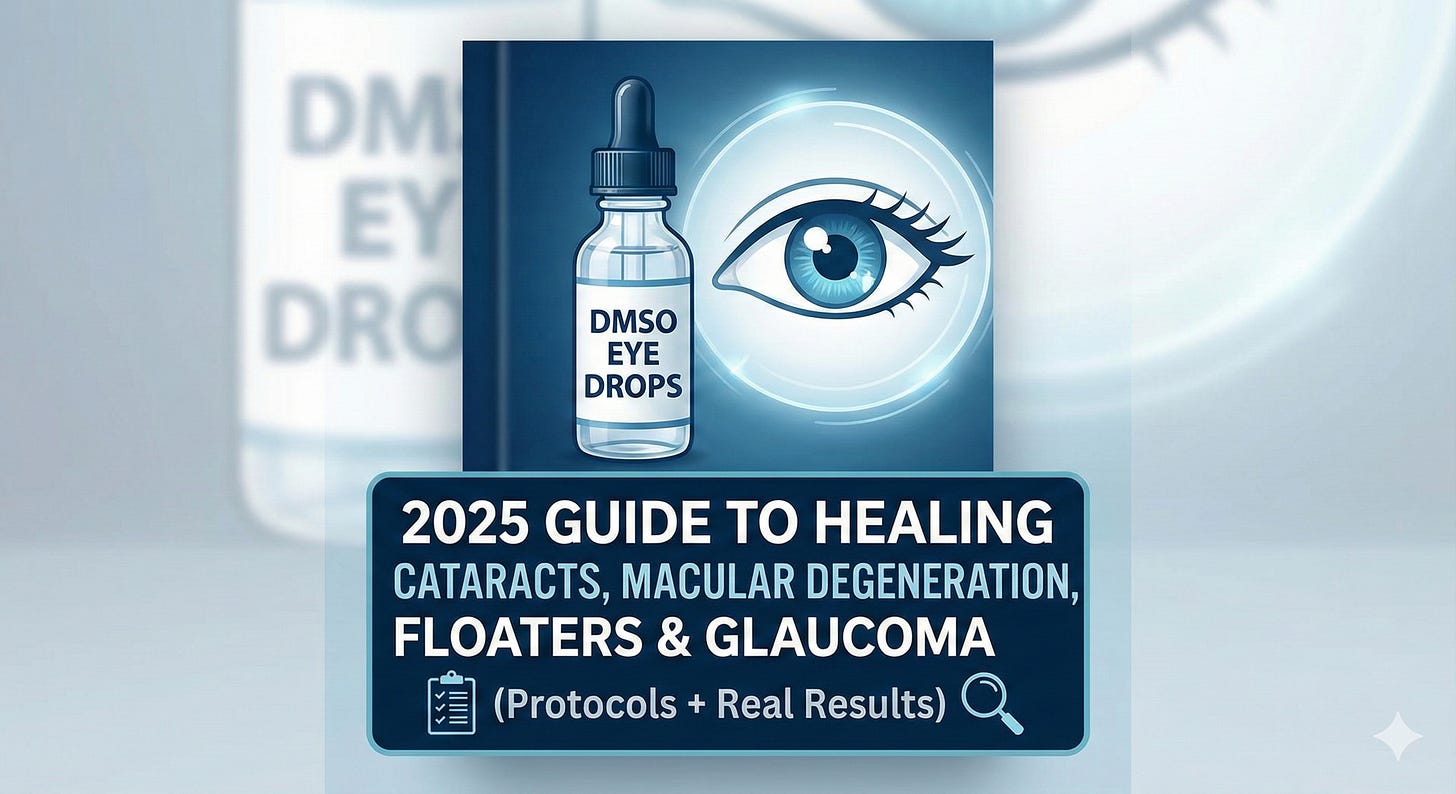
How DMSO May Benefit the Eyes: Proposed Mechanisms
DMSO's unique biological behavior makes it theoretically compelling for ocular use. It penetrates biological membranes faster than almost any other compound, and it carries other molecules with it. The proposed mechanisms for eye benefit include:
- Anti-inflammatory and antioxidant activity — Reduces tissue swelling and protects retinal cells from oxidative stress and ischemia.
- Improved microcirculation — Increases blood flow to oxygen-starved ocular tissues, potentially benefiting the optic nerve and retina.
- Protein stabilization and aggregate dissolution — May help break up lens opacities (cataracts) or vitreous debris (floaters). Chemically plausible; clinically unproven in humans.
- VEGF inhibition — DMSO has been shown to inhibit vascular endothelial growth factor (VEGF), the same target as costly injectable anti-VEGF drugs used for wet AMD and diabetic retinopathy.
- Cell reactivation — May help "dormant" retinal cells recover function in degenerative conditions.
- Intraocular pressure reduction — May relieve glaucoma-associated pressure via edema reduction or ciliary muscle relaxation.
- Enhanced drug delivery — Documented ability to boost penetration of co-applied compounds including steroids, antifungals, vitamin C, glutathione, N-acetylcarnosine, and lanosterol.
When blended with castor oil, the combination adds lubrication via the oil's emollient properties and ricinoleic acid's established anti-inflammatory and hydrating effects.
The Science: What the Evidence Actually Shows in 2026
Evidence for DMSO in ophthalmology falls into three tiers that must not be conflated.
| Evidence Tier | What It Includes | Strength |
|---|---|---|
| Tier 1 — Mechanistic & Preclinical | Cell culture studies, animal models, pharmacology reviews | Moderate |
| Tier 2 — Anecdotal & Observational | Self-reported outcomes, case reports, community aggregations | Low |
| Tier 3 — Controlled Human Trials | Randomized, controlled trials with measured outcomes | Low — largely absent for DMSO ocular use |
Older Human Studies (1960s–1980s)
- 1968 study: 157 eyes treated with 7.5–66% DMSO for up to 19 months. Improvements were noted and no toxicity was observed.
- 1970s retinitis pigmentosa trials: Approximately 50 patients; ~44% showed improved visual acuity, ~18% showed better visual fields, and some night vision gains persisted for years.
- High-concentration studies (up to 100% on eyelids or diluted drops): No permanent lens or retinal changes were observed in humans, unlike concerns raised in some early animal models.
- Critical counterpoint (1983): A placebo-controlled study in which 123 people with retinitis pigmentosa received topical DMSO drops for up to 7 years found no significant benefits for visual acuity, color vision, visual fields, dark adaptation, electroretinography, or electrooculography. This is the only placebo-controlled human trial and it returned a negative result.
Recent Reviews and Animal Data (2020–2026)
- 2021 peer-reviewed review (J Ocul Pharmacol Ther, Hoang et al.): DMSO demonstrates favorable outcomes with low to no toxicity across a range of eye diseases. This remains the most comprehensive review paper on DMSO in ophthalmology and a useful reference for clinicians who are skeptical of off-label ocular use. The same review notes that DMSO is "nonpatentable" and lacks the rigorous trial data required for standard ophthalmologic practice.
- 2025 rat diabetic retinopathy model (Hwang et al., In Vivo): Subconjunctival injection of 10–50% DMSO preserved retinal function, reduced inflammation, and slowed cataract progression. The 50% concentration group showed significantly higher ERG B-wave amplitude and enhanced flicker responsiveness compared to diabetic controls. DMSO inhibited VEGF-driven neovascularization — the same pathway targeted by expensive anti-VEGF injectables.
- Veterinary medicine: DMSO shows 80–90% resolution rates for keratitis, uveitis, and ocular infections in dogs and horses. This is the strongest real-world use case with consistent outcomes.
- Lanosterol combination: N-acetylcarnosine, glutathione, and lanosterol have been mixed with DMSO to create eye drop formulations for cataract prevention. Note that a 2019 controlled study found lanosterol alone failed to restore lens clarity in humans (Daszynski et al., Sci Rep), though DMSO's role as a carrier may alter bioavailability.
Anecdotal and Community Reports
The largest aggregations of user experience come from A Midwestern Doctor's 17,000-word compilation and Robert Yoho MD's Substack summaries. Across thousands of reports, users describe:
- Floaters vanishing or substantially reducing within days to weeks.
- Cataracts clearing or stabilizing; some users report avoiding scheduled surgery after several months of use.
- Macular degeneration: Vision improvements such as 20/200 → 20/50; Amsler grid distortions resolving; night driving restored.
- Glaucoma: Intraocular pressure normalization without medications; perceived optic nerve protection.
- Retinitis pigmentosa: Sustained gains reported when treatment is continued long-term.
- Dry eyes and blepharitis: Rapid relief in cases where steroids had failed.
- Presbyopia and nearsightedness: Reduced dependence on glasses, with 0.25–1+ diopter improvements reported.
- Dramatic cases: Lifelong impairment with restored color perception; legally blind injuries healing within 24 hours; diabetic pets regaining sight.
Robert Yoho MD highlights DMSO as a transformative eye treatment, citing his own macular improvement and dozens of reader successes. He notes that eyelid application at 70% concentration often works as well as direct drops with significantly less stinging.
A notable community observation from our comments section: one reader — an amateur golfer aged 71 — had been using DMSO topically on joints and scar tissue for over a year with no ocular application, and began noticing improved distance vision and reading without glasses. This is consistent with systemic absorption via skin potentially producing ocular effects.
Why DMSO Became Controversial — The History
In the 1960s, DMSO was researched extensively and considered a potential breakthrough for dozens of conditions. Then concerns arose from animal studies — notably about lens changes in some species — and regulators moved to halt widespread development. The FDA ultimately approved DMSO only for intravesical (bladder) treatment of interstitial cystitis.
What followed was a pattern familiar in integrative medicine: a promising compound with insufficient funding for RCTs (partly because it is nonpatentable), a narrative of pharmaceutical suppression, and a devoted community of advocates who continued to use it outside clinical settings. Both the suppression narrative and the uncritical enthusiasm deserve skepticism. The compound is genuinely interesting. The evidence base is genuinely incomplete.
Practical Protocols
Important prerequisite: Always use pharmaceutical-grade (99.99% pure) DMSO stored in glass containers. Industrial-grade DMSO is not appropriate for any ophthalmic use. Start at the lowest effective concentration. These protocols are aggregated from experienced users — they are not medical prescriptions.
Protocol 1 — Basic DMSO Eye Drops
- Dilute to 5–20% in sterile saline (1 part DMSO + 4–19 parts saline).
- 1–2 drops per eye, 1–3× daily.
- For more aggressive approaches: some users go to 40–50% (expect increased stinging).
- Beginners: start at 10% for 1 week before considering increases.
Protocol 2 — DMSO + Castor Oil Blend (Dry Eyes / Cataracts)
- 50/50 blend: organic cold-pressed castor oil + pharmaceutical-grade DMSO.
- Shake well before each use.
- 1 drop per eye, 1–3× daily.
- Particularly popular for dry eye syndrome and early cataract management.
Protocol 3 — Eyelid / Topical Application (Less Irritating)
- Apply 50–70% DMSO to closed eyelids, temples, or the back of the neck.
- DMSO absorbs systemically and reaches the eyes without direct ocular contact.
- Preferred by users sensitive to stinging or those with compromised corneal integrity.
- The community observation noted above (golfer with improved vision) may represent this mechanism in action.
Protocol 4 — DMSO + Additives (Condition-Specific)
- Cataracts: Add vitamin C, glutathione, N-acetylcarnosine, or lanosterol to the DMSO solution to enhance lens penetration of these agents.
- Infections / inflammatory: DMSO combined with diluted dexamethasone or antifungal agents — requires medical supervision.
- Oral adjunct: 1–5 tsp DMSO in water daily — some users report this amplifies ocular effects, possibly via systemic anti-inflammatory action.
- Timing: Wait a minimum of 2 hours between DMSO application and any other prescribed eye medication.
Safety, Side Effects, and the Risks Most Articles Skip
Common Side Effects
- Temporary stinging or burning lasting 20–60 seconds after application.
- Brief blurred vision immediately after drops.
- Garlic-like breath or body odor (due to DMSO metabolites — harmless but notable).
- Transient dryness in some users.
Concentration Matters
This is a critical and often misunderstood point. Concentrations above 50–70% frequently worsen inflammation rather than reducing it. Concentrations of 30–50% or below are generally anti-inflammatory. High-concentration formulations that cause significant tissue injury are not being therapeutic — they are being caustic.
The Contamination Risk — The Biggest Danger Nobody Discusses
- Any DMSO product that is not pharmaceutical grade is inappropriate for ocular use.
- Home dilution without sterile technique (sterile water, sterile containers, aseptic handling) introduces real infection risk.
- Burning or irritation does not equal therapeutic action — it may signal corneal stress or tissue injury.
- No validated sterility standard exists for DMSO ophthalmic preparations because no approved ophthalmic product exists.
No Confirmed Human Toxicity at Therapeutic Doses
The 1960s animal concerns about lens changes were not replicated in human studies using therapeutic concentrations. The 2021 review (Hoang et al.) concluded that DMSO demonstrates low to no toxicity at therapeutic ocular doses. However, the absence of confirmed toxicity is not the same as established safety in the absence of long-term controlled data.
Regulatory Status
- FDA-approved: intravesical instillation for interstitial cystitis only.
- Ophthalmic use: off-label, experimental, and unsupported by approved indications as of 2026.
Evidence Status and Clinical Responsibility (2026)
DMSO's ocular story is one of genuine mechanistic interest surrounded by an evidence vacuum. The 2021 Journal of Ocular Pharmacology and Therapeutics review represents the best available synthesis of preclinical and early clinical data, and its conclusions — that DMSO is biologically interesting and low-toxicity — are legitimate. But as the same review notes, it remains nonpatentable and outside the commercial incentives that drive RCT funding.
The 2025 rat diabetic retinopathy study adds a meaningful data point: DMSO at therapeutic concentrations preserved retinal function and inhibited VEGF in an animal model that closely mirrors human disease progression. This is hypothesis-generating, not practice-changing.
Until controlled human trial data exists:
- DMSO eye drops remain an experimental intervention for all major eye conditions.
- Conditions including glaucoma, macular degeneration, retinal detachment, and progressive vision loss require prompt evaluation by a qualified ophthalmologist. Do not delay evidence-based ophthalmic care.
- DMSO should not replace anti-VEGF injections, cataract surgery, glaucoma medications, or other proven therapies.
- The most responsible use case may be as an adjunct while maintaining standard care, under physician awareness.
What to Do If You Are Considering DMSO for Your Eyes
- Get a full eye examination and formal diagnosis first. Do not self-diagnose the condition you intend to treat. Many of the conditions discussed here — macular degeneration subtypes, glaucoma, early vs. mature cataracts — require specialist imaging to characterize properly.
- Discuss with your ophthalmologist. Many are unaware of the existing literature; the 2021 Hoang et al. review is a useful reference to bring. Some integrative-oriented ophthalmologists are familiar with DMSO's history.
- Source pharmaceutical-grade DMSO only. 99.99% purity, glass container, verified supplier. See product links below.
- Start conservatively and monitor closely. Begin at 10–15% concentration. Document your baseline visual acuity with your ophthalmologist before starting and at regular intervals.
- Combine with evidence-based vision support:
- Lutein (10 mg) + zeaxanthin (2 mg) daily — AREDS2 evidence base for AMD.
- Omega-3 fatty acids (EPA/DHA) — anti-inflammatory, dry eye support.
- Blood glucose control — critical for diabetic retinopathy and cataract risk.
- UV protection — protective sunglasses.
- Blood pressure management — directly relevant to glaucoma and macular perfusion.
Conclusion
DMSO presents a genuinely interesting pharmacological profile for ophthalmology: anti-inflammatory, antioxidant, VEGF-inhibiting, penetration-enhancing, and supported by a body of preclinical and historical data that is more substantial than its mainstream obscurity suggests. The 2025 animal study on diabetic retinopathy adds to a mechanistic case that deserves rigorous clinical investigation.
At the same time, the only placebo-controlled human trial ever conducted — the 1983 retinitis pigmentosa study — found no significant benefit. The anecdotal record, while large and compelling, cannot substitute for controlled methodology. The contamination risk is real and under-appreciated. The absence of an approved ophthalmic formulation means there is no validated product, no established dose, and no safety data from modern trials.
Balance curiosity with caution. The eyes are not an appropriate site for poorly characterized experiments. But for patients whose conditions are failing standard care, who understand the evidence limitations, and who proceed with pharmaceutical-grade materials, physician awareness, and careful monitoring — DMSO remains one of the more biologically plausible options at the margins of conventional ophthalmology.
Vision is precious. Start with what is proven. Add what is plausible with care.
FAQ
Have questions about this article? Ask the AI Assistant.
Q: Is DMSO FDA-approved for eye use?
No. DMSO's only FDA approval is for intravesical instillation in interstitial cystitis. All ophthalmic applications are off-label and experimental as of 2026.
Q: What concentration is safest to start with?
Most experienced users recommend starting at 10–15% in sterile saline. Concentrations above 50% are more likely to cause irritation and tissue stress than therapeutic benefit.
Q: Can DMSO applied to the skin affect the eyes?
There is strong evidence that systemic absorption following topical skin application can produce ocular effects. Several user reports — including those applying DMSO for joint pain — describe spontaneous vision improvement consistent with this mechanism.
Q: Is DMSO a substitute for cataract surgery or anti-VEGF injections?
No. There is no controlled human evidence that DMSO reverses established cataracts or provides equivalent efficacy to anti-VEGF therapy for wet AMD or diabetic macular edema. These conditions require specialist evaluation and evidence-based treatment.
Q: What is the best evidence for DMSO in ophthalmology?
The 2021 review by Hoang et al. in Journal of Ocular Pharmacology and Therapeutics (PMID: 34314611) is the most comprehensive peer-reviewed synthesis. The 2025 subconjunctival DMSO study in diabetic retinopathy rats (Hwang et al., PMID: 39740902) is the most recent animal data. Both are freely accessible and appropriate to share with a skeptical ophthalmologist.
Q: Can someone with an intraocular lens (post-cataract surgery) use DMSO drops?
No controlled data exists for this population. Proceeding at very low concentrations (10–15%) under ophthalmologist awareness would be the minimum precaution. Most IOL patients retain some residual ocular tissue that could theoretically benefit from DMSO's anti-inflammatory properties, but this is speculative.
Sources and Further Reading
From OneDayMD
- DMSO and Castor Oil Eye Drops for Cataracts, Macular Degeneration, Floaters, Vision (2025)
- DMSO 101: Benefits, Uses, Dosage and Side Effects
- DMSO for Stroke, Brain Injury, Spinal Cord Trauma, and Ischemic Damage (2026)
- DMSO and Cancer: The Overlooked Therapy That Could Change Everything
- DMSO for Long COVID: Protocol That's Helping Thousands Recover
- DMSO for Respiratory Diseases — What if This Banned Therapy Worked Better Than Steroids and Inhalers?
- DMSO: A Versatile Compound for Eye Health and Vision Restoration
- A Woman Facing a Lung Transplant Reversed Her Condition with DMSO
From A Midwestern Doctor (The Forgotten Side of Medicine)
- How DMSO Cures Eye, Ear, Nose, Throat and Dental Disease
- How DMSO Protects and Heals the Internal Organs
- The Remarkable History and Safety of DMSO
- DMSO Revolutionizes Skin Care and Dermatology
- How DMSO Treats "Incurable" Autoimmune and Contractile Disorders
- DMSO is a Miraculous Therapy for Chronic Pain and Musculoskeletal Injuries
- DMSO Transforms the Treatment of Infectious Diseases
Peer-Reviewed and Reference Sources
- Hoang et al. Application of Dimethyl Sulfoxide as a Therapeutic Agent and Drug Vehicle for Eye Diseases. J Ocul Pharmacol Ther. 2021. PMID 34314611
- Hwang et al. Therapeutic Potential of Dimethyl Sulfoxide via Subconjunctival Injection in a Diabetic Retinopathy Rat Model. In Vivo. 2025. PMID 39740902 | PMC11705140
- Madsen et al. Systematic review of DMSO safety. 2019. PMC6707402
- Daszynski et al. Failure of Oxysterols Such as Lanosterol to Restore Lens Clarity from Cataracts. Sci Rep. 2019. doi:10.1038/s41598-019-44676-4
- Garcia et al. Placebo-controlled trial of DMSO in retinitis pigmentosa. Ann N Y Acad Sci. 1983. (Negative result — 123 patients, 7 years, no significant benefit.)
- Dimethyl sulfoxide: a solvent that may solve selected cutaneous clinical challenges (2023). Research with Rutgers
Free Download
DMSO Products — Amazon (Affiliate Links)
Buy pharmaceutical-grade DMSO on Amazon
Article last updated: June 2026. Original publication: November 2025. ©️ OneDayMD.com

.png)


.png)
Comments
Post a Comment