Topical Ivermectin for Rosacea, Psoriasis, Eczema, Acne and Scabies (2026)
📌 Clinical Takeaways
Topical ivermectin is a versatile dermatological agent combining potent anti-parasitic action against microscopic skin mites with powerful anti-inflammatory effects. While FDA-approved for papulopustular rosacea (1% cream) and head lice (0.5% lotion), compelling clinical research supports its off-label efficacy in scabies, psoriasis, acne, perioral dermatitis, and post-viral dermatoses.
2. Dual Mechanism of Action: Antiparasitic & Anti-Inflammatory
3. FDA-Approved Indications (Rosacea & Head Lice)
4. Off-Label Dermatological Applications (Psoriasis, Scabies, Acne)
5. Combination Therapies: The "Triple Cream" Approach
6. Comparative Analysis Matrix
7. How to Apply & Managing the "Demodex Die-Off" Reaction
8. Safety Profile, Precautions & Side Effects
9. Frequently Asked Questions (FAQ)
10. References & Medical Disclaimer
1. What is Topical Ivermectin?
Topical ivermectin is a broad-spectrum anti-parasitic and anti-inflammatory dermatological medication derived from avermectins—a class of macrocyclic lactones discovered from soil actinomycetes. While originally famed for revolutionizing global infectious disease control, topical formulations of ivermectin have emerged as frontline therapies in dermatology.
Commercially available under brand names like Soolantra® (1% cream) and Sklice® (0.5% lotion), as well as generic equivalents, topical ivermectin targets skin-dwelling micro-organisms while simultaneously calming cutaneous inflammatory cascades.
2. Dual Mechanism of Action: Antiparasitic & Anti-Inflammatory
Topical ivermectin stands out among dermatological agents because of its dual-action therapeutic profile:
A. Direct Antiparasitic Effect
Ivermectin selectively binds with high affinity to glutamate-gated chloride channels found in invertebrate nerve and muscle cells. This binding causes hyperpolarization of the nerve cell membrane, resulting in paralysis and death of ectoparasites such as:
- Demodex folliculorum & Demodex brevis: Microscopic hair follicle mites implicated in rosacea, blepharitis, and perioral dermatitis.
- Pediculus humanus capitis: Head lice.
- Sarcoptes scabiei: Human itch mites responsible for scabies.
B. Targeted Anti-Inflammatory Pathways
Beyond killing parasites, ivermectin exerts direct immune-modulating effects on human keratinocytes and immune cells. It suppresses the nuclear translocation of Nuclear Factor-kappa B (NF-κB), thereby downregulating inflammatory cytokine production—specifically Interleukin-1β (IL-1β), Interleukin-6 (IL-6), Interleukin-8 (IL-8), and Tumor Necrosis Factor-alpha (TNF-α).
This potent anti-inflammatory mechanism explains why topical ivermectin effectively clears non-parasitic autoimmune and inflammatory skin diseases like psoriasis and eczema.
3. FDA-Approved Indications
1. Papulopustular Rosacea (1% Cream / Soolantra)
Topical ivermectin 1% cream is FDA-approved for treating inflammatory lesions (papules and pustules) associated with subtype 2 rosacea. Clinical trials demonstrate superior efficacy compared to metronidazole 0.75% gel and azelaic acid 15% gel, providing significantly higher rates of complete lesion clearance and longer disease-free remission periods.
2. Head Lice Infestation (0.5% Lotion / Sklice)
Topical ivermectin 0.5% lotion is FDA-approved for treating head lice in adults and pediatric patients six months of age and older. A single 10-minute application paralyzes lice and nymphs. Because of its high efficacy, tedious nit combing is generally unnecessary following treatment.
4. Off-Label Dermatological Applications
A. Psoriasis Vulgaris
Psoriasis is a chronic, immune-mediated inflammatory skin condition characterized by keratinocyte hyperproliferation and erythematous plaques with silvery scales. Conventional therapies often require months to yield results.
Emerging research, including a landmark 2025 case series of 13 patients, highlights topical ivermectin as an innovative intervention for plaque psoriasis. By inhibiting NF-κB pathways and interrupting localized cytokine storms, topical ivermectin induces rapid plaque clearance—often within days to weeks—offering a promising alternative for recalcitrant lesions.
B. Scabies (Sarcoptes scabiei)
Although oral ivermectin and topical permethrin 5% cream are standard frontline scabies remedies, topical ivermectin 1% cream shows equal or superior efficacy in clinical trials. It is particularly valuable for permethrin-resistant scabies infestations, sensitive pediatric skin, or patients experiencing severe post-scabietic eczema.
C. Acne Vulgaris & Perioral Dermatitis
In patients with adult papulopustular acne or perioral dermatitis refractory to classical antibiotics and retinoids, underlying Demodex overgrowth and follicular inflammation are frequently present. Topical ivermectin normalizes the skin microbiome, reduces follicular papules, and restores epidermal barrier integrity without causing antibiotic resistance.
D. Post-COVID & Spike Protein-Associated Dermatoses
Clinicians have documented an emerging subset of persistent cutaneous eruptions (such as microvascular rashes, persistent facial flushing, and post-viral eczema) following SARS-CoV-2 illness or vaccination. Off-label topical ivermectin has shown clinical utility in dampening these localized immune-mediated vascular and epidermal reactions.
5. Combination Therapies: The "Triple Cream" Approach
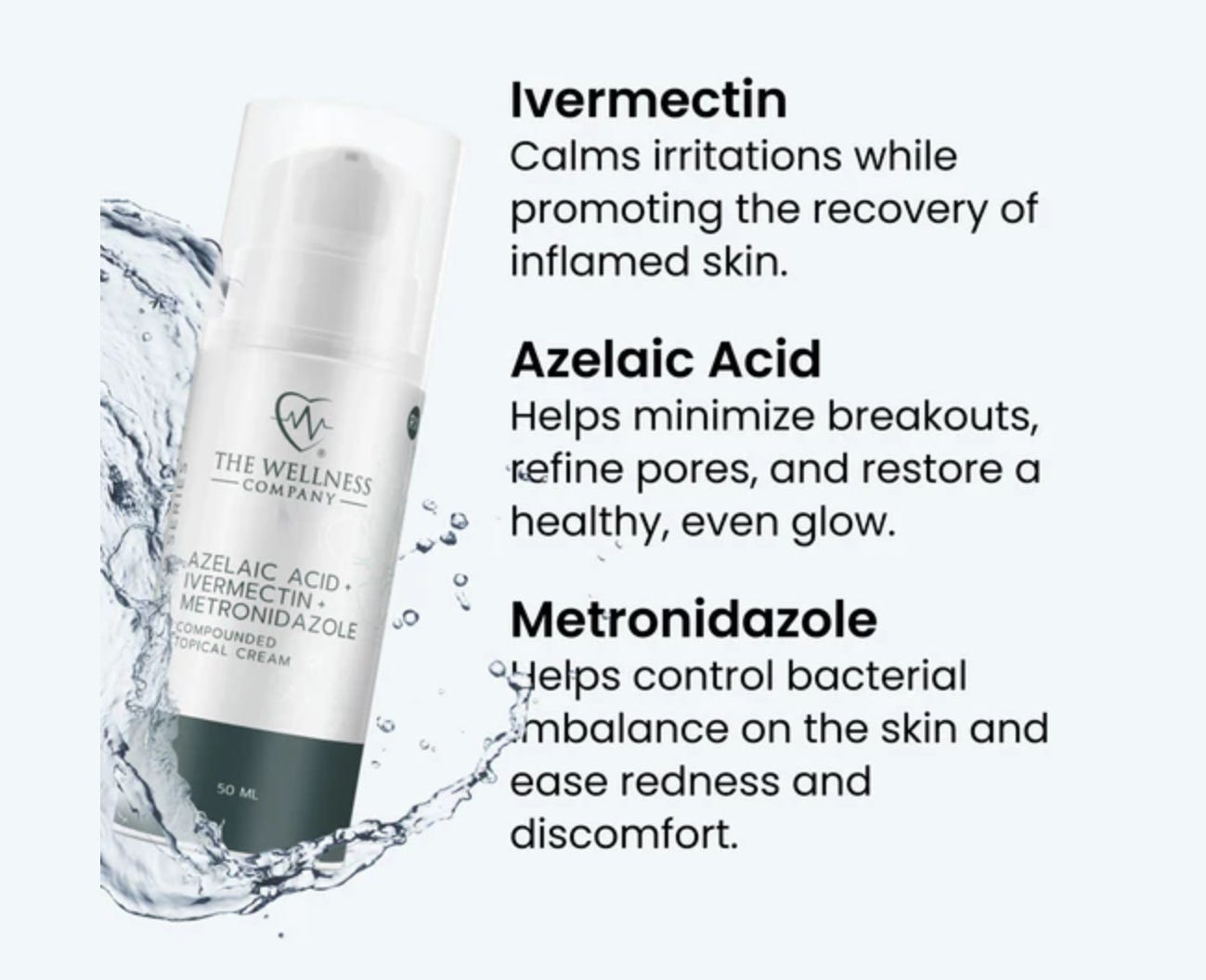
To maximize therapeutic outcomes for complex dermatoses like severe rosacea, acne, and seborrheic dermatitis, compounding pharmacies and clinical specialists frequently utilize a customized multi-action formulation known as Triple Cream:
💡 The Synergistic "Triple Cream" Formula:
- Ivermectin (1%): Eliminates Demodex mites and suppresses IL-1β / TNF-α inflammatory cytokines.
- Azelaic Acid (15%): Unclogs pores, exerts keratolytic activity, reduces hyperpigmentation, and kills acne-causing bacteria.
- Metronidazole (1%): Provides broad antibacterial activity and reduces oxidative tissue stress.
6. Comparative Analysis Matrix
| Condition | FDA Status | Standard Strength | Primary Mechanism | Expected Onset |
|---|---|---|---|---|
| Papulopustular Rosacea | FDA-Approved | 1% Cream | Mite eradication + cytokine reduction | 2 - 4 Weeks |
| Head Lice | FDA-Approved | 0.5% Lotion | Nerve paralysis of lice & nymphs | 24 Hours (Single application) |
| Scabies | Off-Label | 1% Cream | Sarcoptes scabiei eradication | 1 - 2 Weeks |
| Psoriasis Vulgaris | Off-Label / Emerging | 1% Cream | NF-κB inhibition & plaque suppression | 1 - 3 Weeks |
| Acne & Perioral Dermatitis | Off-Label | 1% Cream / Combination | Follicular microbial balancing | 2 - 6 Weeks |
7. How to Apply & Managing the "Demodex Die-Off" Flare
Application Protocol for Rosacea & Facial Dermatoses:
- Wash face with a mild, non-comedogenic cleanser and gently pat dry.
- Apply a pea-sized amount to each of the five areas of the face: forehead, chin, nose, and both cheeks.
- Smooth into a thin layer across the entire face, avoiding immediate eye contact and lips.
- Allow the cream to absorb fully before applying non-comedogenic moisturizers or sunscreens.
- Apply once daily at bedtime.
⚠️ Understanding the "Demodex Die-Off" Reaction
Around Days 3 to 7 of initiating treatment, some patients experience a brief worsening of symptoms—manifesting as increased redness, minor itching, or a surge of small white bumps. This temporary flare is a classic Herxheimer-like reaction known as the Demodex Die-Off.
As thousands of microscopic mites die off simultaneously inside the hair follicles, they disintegrate and release trapped internal bacteria (such as Bacillus oleronius). This triggers a localized immune response. Do not discontinue treatment during this phase—it indicates the medication is actively eliminating the parasite load. Symptoms typically subside within 3 to 5 days, followed by clear skin.
8. Safety Profile, Precautions & Side Effects
Topical ivermectin has minimal systemic absorption, making it significantly safer and better tolerated than oral anti-parasitics or systemic immunosuppressants.
Common Mild Side Effects (<1% of patients):
- Mild skin burning or stinging sensation upon application
- Localized dry skin or mild scaling
- Temporary cutaneous erythema (redness)
Precautions:
- Pregnancy & Lactation: Category C. Use during pregnancy only if potential benefits outweigh risks. Consult your physician.
- Ocular Avoidance: Do not apply directly inside eyelids or eyes. Wash thoroughly with water if accidental contact occurs.
9. Frequently Asked Questions (FAQ)
Q1: How long does topical ivermectin take to work for rosacea?
Most patients observe noticeable reductions in inflammatory bumps within 2 to 4 weeks. Optimal lesion clearance and skin texture improvements are typically achieved after 12 weeks of consistent once-daily use.
Q2: Can I combine topical ivermectin with retinoids or niacinamide?
Yes. Niacinamide strengthens the skin barrier and pairs well with ivermectin. If using prescription retinoids (like tretinoin), introduce them on alternating nights to prevent excessive dryness or irritation.
Q3: Is ivermectin cream available over the counter?
In the US and most regions, 1% ivermectin cream (Soolantra) requires a prescription. However, 0.5% ivermectin lotion (Sklice) is available over-the-counter for head lice treatment.
Q4: Why does ivermectin clear psoriasis so rapidly?
Unlike standard steroidal topicals that only address superficial inflammation, ivermectin directly suppresses the core NF-κB master switch and blocks key pro-inflammatory cytokines while addressing underlying subclinical microbiome triggers.
10. References & Medical Disclaimer
References:
- Ivermectin and Fenbendazole in the Treatment of Psoriasis: A Case Series of 13 Patients (2025).
- New indications for topical ivermectin 1% cream: a case series study, Advances in Dermatology and Allergology (2019).
- Schaller, M., Gonser, L., Belge, K., Braunsdorf, C., Nordin, R., Scheu, A. and Borelli, C. (2017), Dual anti-inflammatory and anti-parasitic action of topical ivermectin 1% in papulopustular rosacea. J Eur Acad Dermatol Venereol, 31: 1907-1911. https://doi.org/10.1111/jdv.14437.

.png)


.png)

.png)
Comments
Post a Comment