Posts

Showing posts with the label MATH protocol

Paul Marik Protocol Review: Have We Found a “Cure” for Severe Sepsis and Septic Shock?

Background:   The overall mortality in sepsis has decreased quite a bit in the last decade or so, however for a subset of patients, like those with Septic Shock, the mortality still remains high (as high as 50%).  There have been hundreds of studies trying to identify the holy grail to decrease mortality further, but one has not been found thus far.  Marik PE et al [1] published a study in Chest 2016 that has found a potential front runner.  In addition, the authors go on to say, in order to have an impact on a global scale, treatments would not only need to be effective, but also cheap, safe, and readily available; the authors of the following paper may have found just that.. Update (2023):  World-Renowned Physician’s Landmark Research Validated by Medical Journal Following a Nearly Year-Long Investigation What They Did: Electronic Heath Record (EHR) retrospective before-after clinical study Compared the clinical course and outcome of consecutive severe sepsis ...
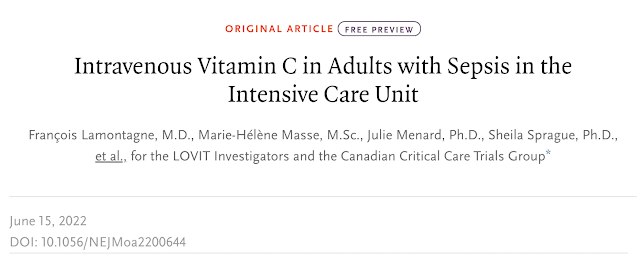
Vitamin C and Sepsis: Surprising results from the LOVIT trial (2023 Update)

Image
Vitamin C turned out to be associated with significant harm when used in patients with sepsis in the intensive care unit (ICU), the LOVIT trial found. For patients receiving vasopressor therapy in the ICU, the endpoint of death or persistent organ dysfunction at day 28 was more common in those who had been randomized to IV vitamin C therapy instead of placebo (44.5% vs 38.5%, risk ratio [RR] 1.21, 95% CI 1.04-1.40), according to Francois Lamontagne, MD, of Université de Sherbrooke in Quebec, and colleagues, writing in the  New England Journal of Medicine . The individual outcomes of mortality (35.4% vs 31.6%, respectively) and persistent organ dysfunction (9.1% vs 6.9%) both trended unfavorably for the vitamin C group but were not significantly different: Mortality: RR 1.17 (95% CI 0.98-1.40) Persistent organ dysfunction: RR 1.30 (95% CI 0.83-2.05) And a secondary analysis of the primary outcome that adjusted for prespecified baseline characteristics was also not significant (RR 1....

Labels

Show more

Archive

Show more