BioShield for Glioblastoma: ImmunityBio's Chemo-Free NK Cell Immunotherapy — 2026 Data Update
In August 2025, ImmunityBio executive chairman Dr. Patrick Soon-Shiong announced early results from five recurrent glioblastoma patients treated with a chemotherapy-free immune-restoring regimen the company calls "BioShield." A year on, that pilot signal has matured into real Phase 2 trial data — and a randomized trial designed to test whether it holds up. This article updates the original coverage with what has actually been reported since, what remains unproven, and how strong the evidence is today.
- What Is "BioShield," Exactly?
- Timeline: From a 5-Patient Pilot to Phase 2 Trial Data
- Lymphopenia and ALC: The Biomarker Behind the Story
- How Strong Is This Evidence, Really?
- ImmunityBio 2026 Snapshot: Approvals, Pipeline, Financials
- Expert Perspective and Open Questions
- Other ImmunityBio Immunotherapy Milestones
- What This Means If You or a Loved One Has Glioblastoma
- Frequently Asked Questions
- Ask an AI: Personalizing This Information
- Sources & Disclosures
1. What Is "BioShield," Exactly?
"Cancer BioShield™" is ImmunityBio's branding for a treatment philosophy, not a single drug: rather than further suppressing the immune system with chemotherapy or radiation, the approach tries to protect and rebuild a patient's own natural killer (NK) cells and T cells so they can attack the tumor.
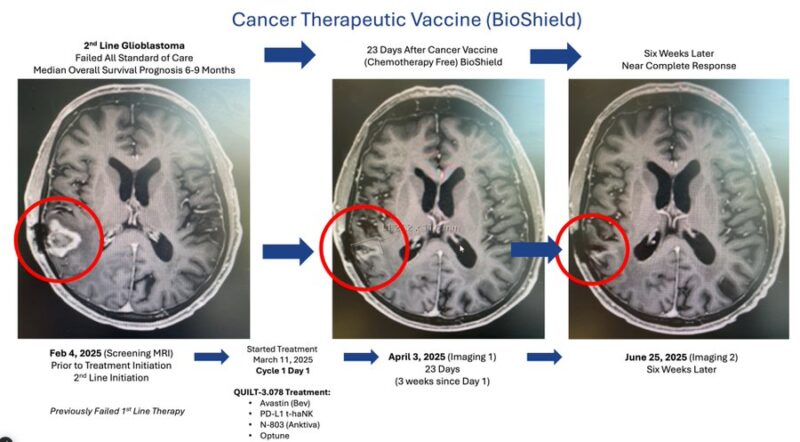
In the glioblastoma program, the regimen under study combines four components:
- ANKTIVA (nogapendekin alfa inbakicept-pmln, N-803) — an IL-15 "superagonist" that signals NK cells and CD8+ T cells to multiply and become more active. It is the only FDA-approved IL-15 superagonist and is ImmunityBio's flagship commercial product.
- PD-L1 t-haNK — an engineered, off-the-shelf NK cell line (derived from the NK-92 platform) designed to target PD-L1-expressing tumor cells, functioning as a form of CAR-NK cell therapy.
- Bevacizumab (Avastin) — a long-established anti-VEGF antibody already used in recurrent glioblastoma to control swelling and slow blood vessel growth around tumors.
- Tumor Treating Fields, delivered via Novocure's Optune Gio device — wearable, alternating electric fields that disrupt cancer cell division.
Notably absent from that list: cytotoxic chemotherapy. That is the basis for calling it a "chemo-free" regimen, and it is the reason ImmunityBio frames the approach around restoring immune competence rather than further depleting it.
2. Timeline: From a 5-Patient Pilot to Phase 2 Trial Data
The original version of this article was written around a series of posts Dr. Soon-Shiong made on X in August 2025. Here is how the picture has changed since, based on ImmunityBio's own disclosures:
| Milestone | What Was Reported |
|---|---|
| August 26, 2025 Initial pilot data | Five patients with recurrent glioblastoma treated. Three of the five responded (two reaching near-complete response), and the remaining two had stable disease — 100% disease control across the small cohort. All five had lymphopenia at baseline that improved on treatment. This is the data the original version of this article covered, sourced from Dr. Soon-Shiong's posts on X and press coverage. |
| January 23, 2026 Phase 2 QUILT-3.078 update | ImmunityBio reported that, as of a January 22, 2026 cutoff, the trial had enrolled 23 patients with recurrent GBM (second-line), with 14 having evaluable follow-up data. 19 of the 23 enrolled patients were alive; 4 deaths had occurred. Median overall survival had not been reached after a median follow-up of about 6 months, and the longest surviving patient had reached 12 months post-recurrence and counting. A parallel group of 18 patients treated under single-patient Investigational New Drug (IND) applications brought the total treated population to 41. Baseline mean ALC of ~0.9 (×10³/µL) rose to ≥1.4 within one treatment cycle (p<0.001). Safety was described as manageable, with 3 treatment-related serious adverse events across 219 total doses. |
| January 31, 2026 | Updated findings were presented by principal investigator Dr. Simon Khagi (Hoag Family Cancer Institute) at the Stand Up To Cancer Glioblastoma Innovation Scientific Summit in Pasadena, California. |
| Since early 2026 | A randomized Phase 2B expansion cohort opened, targeting 20 patients randomized 1:1 to ANKTIVA + bevacizumab + Tumor Treating Fields, with or without the PD-L1 t-haNK cell component — designed to isolate how much benefit the NK cell therapy itself adds. ImmunityBio has also stated it is developing separate randomized trials in both first-line and second-line-or-later glioblastoma. |
The direction of travel is genuinely encouraging for a disease this difficult — but it is worth being precise about what changed: the 2025 story was five patients and a handful of tweets. The 2026 story is a larger, but still uncontrolled and company-reported, Phase 2 dataset. Neither has yet been published in a peer-reviewed journal, and neither has been compared head-to-head against a control arm.
3. Lymphopenia and ALC: The Biomarker Behind the Story
Much of Dr. Soon-Shiong's public commentary on this program centers on a specific lab value: the Absolute Lymphocyte Count (ALC), measured on a routine complete blood count (CBC). In simple terms:
- Standard glioblastoma treatment — surgery, radiation, and temozolomide chemotherapy — frequently damages the bone marrow's ability to produce lymphocytes, the white blood cells (including NK and T cells) responsible for hunting cancer cells.
- A low ALC is called lymphopenia. It is common after radiation and chemotherapy, is under-recognized in routine oncology follow-up, and has been associated in prior research with worse outcomes across several cancer types.
- ImmunityBio's argument is that by using ANKTIVA to raise ALC and reactivate surviving lymphocytes — rather than relying on more cytotoxic therapy that would suppress ALC further — the immune system regains the capacity to help control the tumor.
This is a biologically coherent hypothesis, and the QUILT-3.078 data do show ALC rising on treatment. But a rising lab value is a biomarker, not a survival outcome in its own right — it needs to translate into the trial's actual endpoint (overall survival) in a controlled comparison before it can be considered proof that "fixing" ALC extends life. That confirmation is exactly what the ongoing randomized trials are designed to test.
4. How Strong Is This Evidence, Really?
CEBM Evidence Tier: Level 4
Using the Oxford Centre for Evidence-Based Medicine framework that we apply across this site's oncology coverage, the current glioblastoma BioShield data sits at roughly Level 4 — a single-arm, open-label case series / uncontrolled cohort, reported by the drug's manufacturer via press release and conference presentation rather than a peer-reviewed publication. That is a meaningfully stronger evidence base than the five-patient, social-media-sourced pilot this article originally covered, but it is still well below the Level 1–2 evidence (randomized controlled trials, systematic reviews) that would be needed to say BioShield extends survival in recurrent glioblastoma compared with standard care.
Three specific caveats worth holding onto:
- No control arm yet. "Median overall survival not reached" in 14–23 patients is promising, but without a matched comparison group treated with standard second-line options, it's not possible to statistically attribute the outcome to BioShield rather than to patient selection (e.g., healthier patients well enough to enroll in a trial tend to live longer regardless of treatment).
- Small, evolving numbers. The efficacy population has grown from 5 to 14–23 across two data cuts; ranges this small can shift substantially with a handful of additional events.
- Sponsor-reported. As of this update, the GBM findings have been disclosed through ImmunityBio's own press releases, an investor-facing news release, and a scientific conference presentation — not yet through a peer-reviewed journal article with full statistical detail and independent editorial review.
None of this means the signal isn't real — glioblastoma is notoriously hard to treat, and a chemo-free regimen with a plausible mechanism showing this survival pattern is a legitimate reason for cautious optimism and for the randomized trials now underway. It does mean the evidence isn't yet strong enough to describe BioShield as a proven glioblastoma treatment, and it should not be substituted for standard-of-care discussions with a neuro-oncologist.
5. ImmunityBio 2026 Snapshot: Approvals, Pipeline, Financials
ImmunityBio, Inc. (NASDAQ: IBRX) is a commercial-stage immunotherapy company headquartered in Culver City, California, founded by Dr. Patrick Soon-Shiong (previously known for developing the chemotherapy drug Abraxane). Its lead approved product, ANKTIVA, is the same IL-15 agonist used in the BioShield glioblastoma regimen. Here is where the company's approvals and pipeline actually stand as of mid-2026:
| Indication | Region / Status |
|---|---|
| BCG-unresponsive NMIBC (bladder cancer) with carcinoma in situ, ± papillary disease | Approved — US (2024), UK, EU, Saudi Arabia; commercially authorized across 33 countries in total |
| BCG-naïve NMIBC (carcinoma in situ) | Randomized Phase 2B trial (QUILT-2.005) advancing; company has targeted a supplemental BLA filing in Q4 2026 |
| Metastatic non-small cell lung cancer (NSCLC), + checkpoint inhibitor | Approved in Saudi Arabia only (first lung cancer approval, announced early 2026); confirmatory Phase 3 (ResQ201A, with BeiGene) ongoing for other markets, presented at ASCO 2026 — not yet FDA-approved for lung cancer |
| Recurrent glioblastoma (BioShield regimen) | Investigational only, no approval anywhere. Phase 2 (QUILT-3.078) plus randomized Phase 2B expansion enrolling; separate first-line and second-line randomized trials in development |
| Metastatic pancreatic cancer (2L+) | Single-arm trial (QUILT-88) completed; RMAT designation granted; not yet approved |
| Triple-negative breast cancer | Single-arm trial (QUILT-3.067) completed; randomized follow-on trial in planning |
Financial snapshot: ImmunityBio reported second-quarter 2026 net product revenue (essentially all ANKTIVA sales) of $50.7 million, up 92% year-over-year and its eighth consecutive quarter of sequential growth since ANKTIVA's launch. First-half 2026 revenue reached $94.8 million, up 121% over the same period in 2025, building on full-year 2025 revenue of roughly $113 million. The company held approximately $357 million in cash and marketable securities as of June 30, 2026. The FDA has also accepted a supplemental BLA for ANKTIVA plus BCG in BCG-unresponsive NMIBC, with a PDUFA target date in early January 2027.
On the other side of the ledger, ImmunityBio's GAAP losses widened substantially in the first half of 2026 — driven almost entirely by non-cash accounting charges tied to warrant liabilities and a convertible note, whose fair value moves with the company's own, notably volatile, stock price, rather than by operating cash burn. IBRX shares have swung widely over the past year alongside this string of clinical and regulatory updates.
6. Expert Perspective and Open Questions
Independent commentary on Anktiva-based regimens has generally welcomed the mechanism while cautioning against over-extrapolating it. UK-based integrative oncology writer Jane McLelland, discussing Anktiva's IL-15 biology on her Substack in March 2026, noted that boosting NK and T cell numbers and activity works well when a tumor already sits in an inflamed, immune-accessible environment (as in BCG-treated bladder cancer or inflamed melanoma) — but that IL-15 stimulation alone does not dissolve dense tumor stroma, neutralize immunosuppressive signaling molecules, or generate T cells in patients who are severely and chronically lymphopenic. Her point, in short: the tumor microenvironment matters as much as the immune cell count, and glioblastoma is a notoriously "cold," stroma-rich, blood-brain-barrier-protected tumor — a harder environment for any immune-activating therapy than bladder cancer's inflamed bladder wall.
Dr. Simon Khagi, the trial's principal investigator, has framed the QUILT-3.078 data more cautiously than the company's marketing language, describing the survival pattern as warranting continued follow-up in a population where treatment options are otherwise limited — the standard, appropriately hedged language of someone running an open-label Phase 2 trial, not a declaration of a cure.
7. Other ImmunityBio Immunotherapy Milestones
The glioblastoma program sits inside a broader push to position ANKTIVA as the backbone of ImmunityBio's cell-therapy platform across tumor types:
- Waldenström's macroglobulinemia: In a compassionate-use case shared in January 2026, a patient with relapsed/refractory disease and bone marrow more than 95% replaced by tumor achieved a complete remission after four doses of an off-the-shelf CAR-NK product combined with rituximab, and remained in remission at 15 months with no further therapy at last report. This is a single compassionate-use case, not a trial result, and should be read as hypothesis-generating rather than proof of efficacy in this rare lymphoma.
- Lung cancer: Beyond the Saudi approval noted above, ImmunityBio and partner BeiGene presented Phase 3 NSCLC data (the ResQ201A trial, comparing Anktiva plus tislelizumab and docetaxel against docetaxel alone in ICI-resistant advanced NSCLC) at ASCO 2026.
- Bladder cancer: Remains ImmunityBio's most commercially mature and best-evidenced indication, with the longest track record of randomized and real-world data among its programs.
8. What This Means If You or a Loved One Has Glioblastoma
If this is relevant to your own situation, practical next steps include:
- Ask your neuro-oncology team directly whether you would be eligible for QUILT-3.078 or its randomized Phase 2B expansion, and discuss how it would fit alongside (not instead of) standard second-line options.
- Ask specifically to have your ALC checked as part of your routine CBC after radiation or chemotherapy — it is not a standard discussion point in most oncology visits today, but it is simple to obtain and clinically informative regardless of which treatment you pursue.
- Search the trial's official record at clinicaltrials.gov/study/NCT06061809 for current enrollment status and participating sites, and ImmunityBio's own glioblastoma program page for additional context.
- Treat single-patient anecdotes and company press releases — including everything in this article — as a starting point for a conversation with your own oncology team, not as a substitute for it.
9. Frequently Asked Questions
Is BioShield approved by the FDA for glioblastoma?
No. ANKTIVA is FDA-approved only for BCG-unresponsive non-muscle-invasive bladder cancer, in combination with BCG. The glioblastoma "BioShield" regimen (Anktiva + PD-L1 t-haNK + bevacizumab + Tumor Treating Fields) is investigational and available only through the QUILT-3.078 clinical trial or single-patient IND arrangements.
What were the original 2025 results for glioblastoma?
Five recurrent glioblastoma patients were treated in a pilot cohort announced in August 2025. Three of the five responded (two near-complete responses), and the remaining two had stable disease, for 100% disease control across the small group — the basis for the original version of this article.
What do the updated 2026 results show?
As of a January 22, 2026 data cutoff from the Phase 2 QUILT-3.078 trial, 19 of 23 enrolled patients were alive, and median overall survival had not been reached at roughly 6 months' median follow-up — a favorable pattern against the historical 6–9 month benchmark for recurrent glioblastoma, though not yet confirmed in a randomized comparison.
What is ANKTIVA and how is it different from chemotherapy?
ANKTIVA (nogapendekin alfa) is an IL-15 superagonist that stimulates a patient's own natural killer and T cells to multiply and become more active, rather than killing cancer cells directly the way chemotherapy does. It is designed to work with the immune system rather than suppress it.
What is ALC and why does it matter here?
ALC (Absolute Lymphocyte Count) is a routine blood test measuring the number of lymphocytes, including the NK and T cells responsible for immune surveillance against cancer. Standard glioblastoma treatment often depletes ALC (lymphopenia); ImmunityBio's hypothesis is that restoring ALC with Anktiva helps the immune system contribute to tumor control.
How strong is the evidence that BioShield works for glioblastoma?
Currently it sits at roughly CEBM Level 4 — an open-label, single-arm, company-reported dataset without a control group or peer-reviewed publication. It is encouraging early-phase data, not proof of a survival benefit; randomized trials are underway to test that question directly.
Is ImmunityBio's ANKTIVA approved for lung cancer in the United States?
Not yet. Anktiva plus a checkpoint inhibitor was approved for metastatic NSCLC in Saudi Arabia in early 2026 — ImmunityBio's first lung cancer approval anywhere — while a Phase 3 confirmatory trial (with BeiGene) is ongoing for other markets, including the US.
10. Ask an AI: Personalizing This Information
Large language models can help you translate this kind of trial update into questions worth raising with your own oncology team. They cannot replace that team, verify your specific eligibility, or access your medical record unless you provide it directly. A few starting prompts:
- Claude: "Here is my latest MRI and pathology report [paste text]. Can you explain in plain language what 'recurrent, second-line glioblastoma' means for my situation, and what questions I should ask my neuro-oncologist about immunotherapy trials?"
- ChatGPT: "Summarize the difference between a Phase 2 single-arm trial and a randomized Phase 2B trial, using the QUILT-3.078 glioblastoma trial as the example."
- Gemini: "Search for the current enrollment status and locations for clinical trial NCT06061809 and list the closest sites to [your city]."
- Perplexity: "Find any peer-reviewed, published papers (not press releases) on ImmunityBio's Anktiva plus CAR-NK regimen in glioblastoma, and tell me if any have appeared since January 2026."
11. Sources & Disclosures
Primary sources for this update include ImmunityBio's investor relations press releases (January 23, 2026 and August 4, 2026), reporting from Clinical Trials Arena, CancerNetwork, and Rare Cancer News on the January 2026 QUILT-3.078 data, the trial's public record at ClinicalTrials.gov (NCT06061809), and ImmunityBio's own glioblastoma program page. Dr. Soon-Shiong's original August 2025 posts on X and Jane McLelland's March 2026 Substack commentary are linked for attribution rather than reproduced.
Affiliate & Financial Disclosure: As is standard across OneDayMD.com, some links elsewhere on this site may be affiliate links (Amazon Associates; The Wellness Company, referral code ONEDAYMD), for which we may earn a commission at no extra cost to you. None of the ImmunityBio, clinical-trial, or news links in this specific article are affiliate links, and OneDayMD has no financial relationship with ImmunityBio, Inc.
Related Reading
- Ivermectin and Mebendazole for Brain Cancer: 130+ Case Reports
- OneDayMD Cancer Hub — Integrative & Precision Oncology
- In a series of posts on X.com, the ImmunityBio executive chairman called glioblastoma “medicine’s biggest challenge” .
- What's Your ALC?: ImmunityBio's Dr. Pat Soon-Shiong Details Lymphopenia Dangers and Anktiva's Cancer Treatment Role. Dr Patrick posted on X (November 2025) to explain about lymphopenia.
Key QUILT Trials & Focus Areas:
- QUILT-3.032 & QUILT-2.005: Focus on Non-Muscle Invasive Bladder Cancer (NMIBC), using N-803 (ANKTIVA) with BCG, showing high complete response rates in both BCG-naive and BCG-unresponsive patients, with long-lasting remissions.
- QUILT-3.055: Investigates combination immunotherapies (N-803 plus checkpoint inhibitors) in advanced solid tumors, including NSCLC, for patients who have progressed on prior PD-1/PD-L1 therapy.
- Other QUILT Studies: Also explore therapies for pancreatic cancer and other cancers, aiming to activate immune cells (NK cells, T cells) for durable responses.
- Bladder Cancer: High complete response rates (e.g., 71% in BCG-unresponsive NMIBC) with long durations and high rates of avoiding cystectomy (bladder removal).
- NSCLC: Converts patients with stable disease on immunotherapy to responsive disease with the addition of N-803, showing promising overall survival.

.png)


.png)


.png)
Comments
Post a Comment