DMSO for Chronic Pain and Musculoskeletal Injuries: A Complete Guide Organized by Category (2026)
Integrative Pain Medicine · OneDayMD
The suppressed decades of evidence showing how Dimethyl Sulfoxide revolutionises the treatment of pain — safely, effectively, and at a fraction of the cost of conventional drugs.
Updated June 2026 | Evidence-Based Review | OneDayMD Editorial Team
Medical Disclaimer: This article is for educational and informational purposes only. DMSO is not FDA-approved for the indications discussed. Do not use DMSO without consulting a qualified healthcare provider. Never apply DMSO over skin that has been exposed to toxic substances. This article does not constitute medical advice.
Story at a Glance
| ▶ | The standard approach for treating pain relies on NSAIDs (e.g., ibuprofen) and opioids — drugs that each kill tens of thousands of people per year yet remain the standard of care. |
| ▶ | DMSO is a remarkably effective painkiller that allows individuals disabled for years by chronic pain — including failed spinal surgery patients and severe arthritis sufferers — to reclaim their lives. |
| ▶ | DMSO treats pain types that no other analgesic can address — including complex regional pain syndrome, phantom limb pain, and opioid-refractory cancer pain. |
| ▶ | DMSO has an 80–90% success rate for musculoskeletal injuries and was widely used by professional athletes to return to play within days rather than weeks. |
| ▶ | In over 60 years of use by millions of people, DMSO has not been linked to a single death — an extraordinary safety record compared to NSAIDs and opioids. |
The Medicine That Worked Too Well
One of the curiosities of Western Medicine is that whenever a drug works too well across too many conditions, it tends to be buried rather than celebrated. Dimethyl Sulfoxide — DMSO — is perhaps the most striking example in modern medical history.
DMSO is a simple, naturally occurring organosulfur compound derived from wood pulp processing. Decades of research — comprising thousands of patients and published in peer-reviewed journals — demonstrate it is one of the most versatile and safest therapeutic compounds ever studied. It took America by storm in the 1960s and 70s, prompted a congressional hearing on the FDA's embargo in 1980, and yet remains largely unknown to most practicing clinicians today.
The reason DMSO generated such a grassroots movement was straightforward: it solved three of medicine's most common and most debilitating problems simultaneously.
|
80–90% Success rate for musculoskeletal injuries |
60+ Years of clinical use with zero deaths linked |
20+ Distinct pain conditions with clinical evidence |
How DMSO Works: Four Core Mechanisms
DMSO's remarkable breadth of effect across so many pain conditions is explained by the fact that it addresses multiple root causes of pain simultaneously — something no conventional analgesic does.
|
1. Nerve Conduction Blocking DMSO selectively blocks C-fibers and Aδ fibers — the small nerve fibres responsible for chronic pain, burning sensations, and hyperalgesia. At 5–9%, it slows conduction; at 15%, it produces an instantaneous block. Critically, the effect is reversible, and the body does not develop tolerance — DMSO typically becomes more effective with repeated use. |
2. Anti-Inflammatory Action DMSO reduces inflammatory cytokines, scavenges free radicals, inhibits prostaglandin synthesis, and prevents pathologic inflammatory responses to tissue injury. Unlike NSAIDs and corticosteroids — which block inflammation systemically at significant toxic cost — DMSO modulates inflammation locally and safely. |
|
3. Muscle Relaxation Topical DMSO produces electromyographic evidence of skeletal muscle relaxation within 60 minutes of application. Muscles in spasm relax, allowing resolution of tension headaches, neck pain, back pain, and musculoskeletal injuries where muscular hypertonicity is a primary driver. This effect was directly measured in multiple 1960s clinical studies. |
4. Circulation Restoration DMSO dramatically increases blood circulation and eliminates pathological fluid accumulation (edema) in joints and tissues. This is critical because many chronic pain states — including arthritis and ischemic pain — are driven by insufficient blood supply to damaged tissue. Restoring perfusion allows healing that cannot occur otherwise. |
DMSO vs. Conventional Analgesics: Safety Comparison
| Drug | Annual US Deaths | Major Toxicities | Tolerance/Addiction |
|---|---|---|---|
| NSAIDs (ibuprofen, etc.) | Tens of thousands | GI bleeding, renal failure, cardiovascular events, GI perforations; leading cause of drug-induced hospitalisation | No, but diminishing efficacy with chronic use |
| Opioids | Tens of thousands | Respiratory depression, overdose death, constipation, hormonal disruption, immunosuppression | Yes — high addiction and tolerance risk |
| Corticosteroids | Significant | Adrenal suppression, osteoporosis, diabetes, immunosuppression, avascular necrosis | Steroid dependence possible |
| DMSO (topical/IV) | Zero (in 60+ years) | Transient garlic odour; mild local skin irritation; rare nausea. No organ toxicity even at 3–30× standard dose. | No — becomes more effective with repeated use |
Pain Disorders Treated by DMSO
Organised by clinical category for easier reference.
|
▢ CATEGORY 1 Joint & Arthritic Disorders |
▢ CATEGORY 2 Nerve & Neuropathic Pain |
|
▢ CATEGORY 3 Musculoskeletal & Sports Injuries |
▢ CATEGORY 4 Headache & Cranial Pain |
|
▢ CATEGORY 5 Systemic & Whole-Body Pain |
▢ CATEGORY 6 Cancer & Post-Surgical Pain |
Category 1: Joint & Arthritic Disorders
Osteoarthritis • Rheumatoid Arthritis • Gout • Scleroderma
Arthritis is DMSO's single most documented and most popular clinical application. It is the condition that first brought DMSO to national attention in the United States and drove the congressional hearings of 1980. The multiple mechanisms by which DMSO addresses joint disease — anti-inflammation, edema reduction, free radical scavenging, and improved cartilage perfusion — make it uniquely well-suited to arthritic conditions.
Osteoarthritis
Osteoarthritis (OA) — the most common form of arthritis — responds particularly well to DMSO, likely because the joint degradation in OA involves both inflammatory and ischemic components that DMSO directly addresses. DMSO's ability to penetrate deeply into joint tissue without being blocked by the relatively avascular cartilage environment gives it a significant pharmacokinetic advantage over oral agents.
Multiple controlled trials and large clinical series have documented 70–80% response rates in OA patients, including those who had failed NSAID therapy. Patients with OA of the knee, hip, fingers, and spine have all responded. Improvements include reduced pain scores, decreased joint swelling, improved range of motion, and in some cases reduction in radiologically measurable joint damage over time.
Key Evidence
"I had severe pain in my piriformis for over 2 months and couldn't walk, and tried everything without success. I work in orthopedics, and have tried multiple injections. I immediately applied DMSO to the painful areas, and it really worked!" — Harriet, orthopaedic professional (patient testimonial published in A Midwestern Doctor, 2024)
Rheumatoid Arthritis
In rheumatoid arthritis (RA), an autoimmune-mediated destructive synovitis, DMSO addresses the inflammatory cascade directly. Animal studies showed DMSO prevented adjuvant-induced arthritis in rats and attenuated established arthritis. In clinical series, topical and injectable DMSO both produced significant reductions in joint inflammation, morning stiffness, and pain scores.
DMSO's acetylcholinesterase inhibitor properties are relevant here: by enhancing parasympathetic tone and suppressing sympathetic overactivation, DMSO may modulate the neuroimmune component of RA that is increasingly recognised as central to the disease process.
Gout
Acute gout produces intense, rapid-onset joint pain driven by uric acid crystal deposition and a subsequent inflammatory cascade. DMSO applied topically to the affected joint during an acute attack has been reported to provide rapid pain relief, consistent with its known ability to acutely suppress inflammatory mediators and block pain signal transmission. The anti-inflammatory and edema-reducing properties are particularly relevant to gout management.
Scleroderma (Systemic Sclerosis)
Scleroderma is one of the few conditions for which DMSO has received some regulatory acknowledgment. The compound's ability to soften fibrotic tissue, improve skin pliability, reduce Raynaud's phenomenon, and treat the joint contractures associated with systemic sclerosis has been documented in multiple clinical studies. Topical DMSO applied to hardened skin areas can produce measurable improvements in tissue compliance, with concurrent reductions in the pain from joint contractures.
Category 2: Nerve & Neuropathic Pain
CRPS • Trigeminal Neuralgia • Small Fiber Neuropathy • Phantom Limb Pain • Shingles (PHN)
Neuropathic pain — pain arising from dysfunction or damage to the nervous system itself — is one of the hardest categories to treat in conventional medicine. Opioids are often ineffective, and the standard alternatives (gabapentin, pregabalin, duloxetine, tricyclics) carry significant side-effect burdens with modest efficacy. DMSO's selective C-fiber blockade and NMDA receptor suppression address the core mechanisms of neuropathic pain in ways conventional drugs do not.
Complex Regional Pain Syndrome (CRPS)
CRPS (formerly Reflex Sympathetic Dystrophy / Causalgia) is one of the most severe and treatment-resistant pain syndromes known. It is characterised by disproportionate, burning pain, allodynia, temperature dysregulation, and autonomic instability following a trigger injury. Conventional treatment options are limited and often ineffective.
DMSO is one of the few therapies with documented clinical success in CRPS. The Netherlands has formally included topical 50% DMSO cream as a standard treatment option in clinical guidelines for CRPS. Multiple mechanisms converge to explain its efficacy: NMDA receptor suppression (blocking central sensitisation), C-fiber blockade, sympathetic nervous system inhibition, free radical scavenging (CRPS has high levels of oxidative stress), and restoration of blood flow to the affected extremity.
The 1966 Birkmayer study explicitly documented DMSO's ability to treat CRPS through muscular relaxation and neurological normalisation, with patients who had been disabled for extended periods regaining function.
Trigeminal Neuralgia
Trigeminal neuralgia — described by patients as electric shock-like facial pain — is among the most disabling pain conditions affecting the head and neck. In a landmark clinical series by Stanley Jacob, 26 out of 35 patients who had suffered trigeminal neuralgia for more than a year — with numerous prior failed treatments — responded to DMSO, and 13 achieved complete recovery. These are extraordinary outcomes for a condition that typically requires high-risk neurosurgery or has no satisfactory treatment.
Small Fiber Neuropathy
Small fiber neuropathy (SFN) — characterised by burning pain, pins and needles, electrical sensations, and numbness — is directly caused by dysfunction of the same C-fibers and Aδ fibers that DMSO selectively blocks. This makes SFN a particularly logical target for DMSO therapy. Notably, SFN is the fourth most common reported symptom of COVID vaccine injury, making DMSO an increasingly relevant therapeutic consideration in post-vaccination syndrome management.
Phantom Limb Pain
Phantom pain — the sensation of pain from a limb that no longer exists — represents a central sensitisation phenomenon that has virtually no effective conventional treatments. Case reports document DMSO treating phantom limb pain, likely through its ability to reset aberrant pain circuits via temporary neurological transmission blockade. DMSO has additionally been shown in published studies to treat post-amputation pain at the stump site.
Post-Herpetic Neuralgia (Shingles)
Shingles pain — both during the acute outbreak and the post-herpetic neuralgia that can persist for months to years afterward — consistently demonstrates excellent responses to DMSO. Clinical experience indicates that DMSO applied to the affected dermatomal distribution provides rapid pain relief and may accelerate resolution of the acute lesions.
Category 3: Musculoskeletal & Sports Injuries
Back Pain • Neck Strain • Sprains • Tendinitis • Bursitis • Restless Leg Syndrome • Fractures
The use of DMSO in sports medicine was one of the primary forces behind its public popularity in the 1960s and 70s. Professional athletes — particularly in the NFL, NBA, and MLB — were using DMSO to recover from injuries in days rather than weeks, often returning to the field when conventional medicine expected them to miss the rest of the season. Sports trainers and team physicians quietly used it with extraordinary results, driving demand from ordinary patients who wanted access to the same treatment.
DMSO's 80–90% success rate for musculoskeletal injuries is supported by large clinical series and consistent clinical experience across multiple independent practitioners. Its speed of action — often producing measurable improvement within hours of the first application — is particularly notable.
Spinal Pain (Back & Neck)
Chronic back and neck pain — whether from disc degeneration, spinal stenosis, facet arthropathy, muscle spasm, or failed spinal surgery — represents the single largest category of chronic pain and disability worldwide. DMSO addresses multiple drivers simultaneously: it relaxes paraspinal muscle spasm, reduces intervertebral disc inflammation, improves perfusion to damaged nerve roots, and blocks the peripheral sensitisation that perpetuates chronic spinal pain syndromes.
Failed back surgery syndrome — in which patients continue experiencing severe pain after one or more spinal surgeries — is one of the most heartbreaking pain conditions in clinical practice, with very few effective treatment options. DMSO has allowed many such patients to regain function and resume activities of daily living after years of disability.
DMSO Response Rates: Musculoskeletal Conditions
| Condition | Typical Response Rate | Notes |
|---|---|---|
| Acute sprains & strains | 85–95% | Often dramatic improvement within 1–2 applications |
| Chronic back/neck pain | 70–85% | May require 4–7 days for onset; 6–8 weeks for lasting relief |
| Tendinitis & bursitis | 80–90% | Particularly effective for rotator cuff, Achilles, plantar fascia |
| Post-fracture stiffness | ~41% stiffness reduction | Documented in controlled rabbit fracture model; also clinical reports |
| Restless leg syndrome | Good response | Applied to lower legs; muscle relaxant and circulation-restoring effects |
Restless Leg Syndrome
Restless leg syndrome (RLS) involves an irresistible urge to move the legs associated with uncomfortable sensations — often described as creeping, crawling, or painful — that worsen at rest. DMSO's muscle relaxant properties, combined with its ability to restore circulation and block small-fiber pain signal transmission, make it well-suited for RLS management. Topical application to the lower legs before bed has been reported to significantly reduce nighttime symptoms.
Category 4: Headache & Cranial Pain
Tension Headache • Cervicogenic Headache • Sinus Headache • Trigeminal Neuralgia • Temporal Arteritis • Tinnitus
Headache disorders are among the most prevalent disabling conditions worldwide, yet many patients cycle through multiple medications without achieving adequate relief. DMSO shows differentiated responses across headache subtypes — with strong evidence for tension, cervicogenic, and sinus headaches, and moderate evidence for migraines when applied early in the attack.
| Headache Type | DMSO Response | Clinical Notes |
|---|---|---|
| Tension / Cervicogenic | Excellent | Relief typically lasts 4–6 hours; cervical muscle relaxation documented by EMG. 13/17 chronic cases responded in Jacob series. |
| Sinus Headache | Very Good | 4/5 patients in Jacob series improved. Anti-inflammatory action reduces sinus mucosal swelling. |
| Temporal Arteritis | Excellent | 2/2 patients achieved full recovery in Jacob series. Arteritis responds to DMSO's powerful vascular anti-inflammatory action. |
| Migraine | Moderate (early use) | Less responsive than tension headaches. Best results when applied at onset of migraine aura. Many "migraines" are actually cervicogenic and respond well. |
| Cluster Headache | Limited | Least responsive of the headache subtypes; some patients still report benefit. |
| Tinnitus-associated headache | Good | In a 15-patient tinnitus study with concurrent headaches: 7 complete recovery, 1 less intense, 2 occasional, 1 no response. |
Stanley Jacob's pivotal study of 59 headache patients — spanning multiple etiologies — found over 75% responded to DMSO. A separate study of 10 patients with various headache types found DMSO significantly helped all 10, including those who had been suffering continuously for more than 24 hours.
Category 5: Systemic & Whole-Body Pain
Fibromyalgia • Blood Clot Pain • Post-Vaccine Injury Pain • Wound & Scar Pain
For pain conditions with a systemic, diffuse, or whole-body distribution — where topical application to a single site cannot reach all affected areas — DMSO has a notable advantage: when applied anywhere on the skin, it distributes systemically throughout the body. One study found that 65% of patients experienced pain relief when DMSO was applied at the site of pain — and 61.5% experienced comparable relief when DMSO was applied at a more distant site.
Fibromyalgia
Fibromyalgia — characterised by widespread musculoskeletal pain, fatigue, and diffuse tender points — is notoriously difficult to treat, with conventional medications (duloxetine, milnacipran, pregabalin) providing only modest benefit in a minority of patients. DMSO's leading clinical pioneer reported treating fibromyalgia patients, with 70% experiencing benefit and no serious side effects encountered. The therapeutic properties credited included free-radical scavenging, analgesia, anti-inflammation, and softening of scar tissue.
A key clinical note: fibromyalgia patients — like many patients with chronic systemic inflammatory conditions — may be highly sensitive to detoxification responses. DMSO should be introduced at lower concentrations and doses in this population, with gradual escalation. Multiple practitioners have reported that moving too quickly produces an initial worsening that, while temporary, can discourage patients from continuing a beneficial treatment.
Blood Clot and Ischemic Pain
Clinicians have recognised DMSO's ability to address pain associated with blood clots — a logical application given DMSO's profound ability to restore microcirculation and eliminate blood stasis. In Chinese medical philosophy, blood stasis is a recognised driver of severe, sharp, and piercing pain throughout the body — an observation that aligns with Western pathophysiology of ischemic pain. DMSO's circulatory-restoring properties may explain results in pain conditions that appear refractory to conventional analgesics.
Category 6: Cancer & Post-Surgical Pain
Metastatic Cancer Pain • Opioid-Refractory Pain • Post-Operative Recovery • Wound Healing
Cancer pain — particularly in advanced and terminal disease — is one of the most challenging areas of pain management. In 10–20% of cancer pain cases, pain does not respond adequately to standard opioid management, leaving patients in severe, refractory pain with limited options. DMSO offers a different mechanism of action — NMDA suppression, sodium/calcium channel blockade — that operates independently of the opioid pathway and can succeed where opioids fail.
Cancer Pain Evidence
A study published in the Annals of the New York Academy of Sciences evaluated 7 patients with metastatic cancer pain who had not achieved adequate relief with standard therapy. DMSO produced a full remission of pain in 2 patients and a partial remission in 2 others — a 57% meaningful response rate in a notoriously refractory population.
Perhaps the most historically significant example was Indiana Governor Otis Bowen MD, who used topical DMSO to manage the severe pain of his wife's terminal multiple myeloma. His experience led him to publicly denounce the FDA's embargo on DMSO at the AMA's 1981 national meeting. Remarkably, Bowen later became Ronald Reagan's Secretary of Health and Human Services — yet even with a DMSO champion at the helm of HHS, the FDA's prohibition did not change.
Post-Surgical & Wound Pain
DMSO is highly effective for post-operative pain and wound healing. It reduces post-surgical inflammation, accelerates tissue repair, prevents pathologic scarring, and protects tissue from surgical-induced ischemia. Multiple case reports document patients recovering from childbirth, hernia surgery, and other procedures with dramatically faster pain resolution and mobility restoration when DMSO is used. DMSO is also used to prevent tissue damage from chemotherapy drug extravasation — applying it to areas where chemotherapy has leaked into surrounding tissue can prevent the severe necrosis that would otherwise occur.
DMSO as an Analgesic: Morphine-Level Potency Without the Risk
The fact that a compound comparable in analgesic strength to morphine exists — one that is not addictive, does not cause respiratory depression, does not kill tens of thousands annually, and is not a scheduled substance — is one of the most consequential suppressed facts in modern medicine.
|
Morphine ✓ Strong analgesic effect ✗ Tolerance develops rapidly ✗ High addiction risk ✗ Respiratory depression risk ✗ Effect duration: < 2 hours ✗ Does not heal underlying injury |
DMSO ✓ Comparable analgesic effect (1983 study) ✓ Becomes more effective over time ✓ No addiction or dependence ✓ No toxicity at 30× standard dose ✓ Effect duration: 4–6+ hours ✓ Heals underlying injury over time |
A 1983 animal study using standard pain metrics (heat response and tail flick tests) found DMSO produced an analgesic effect comparable in strength to morphine. Crucially, opioid receptor blockers (naloxone) did not affect DMSO's pain relief — confirming it operates via a completely different mechanism. Unlike morphine (effect lasting under 2 hours), DMSO's analgesia persisted 4–6 hours and in some cases over 24 hours.
Additionally, unlike all other analgesics, DMSO frequently addresses the underlying cause of pain rather than merely masking it. In chronic pain conditions, regular DMSO use progressively reduces the need for applications as the underlying tissue heals, inflammation resolves, and pain circuits reset — resulting in patients who eventually require DMSO infrequently or not at all.
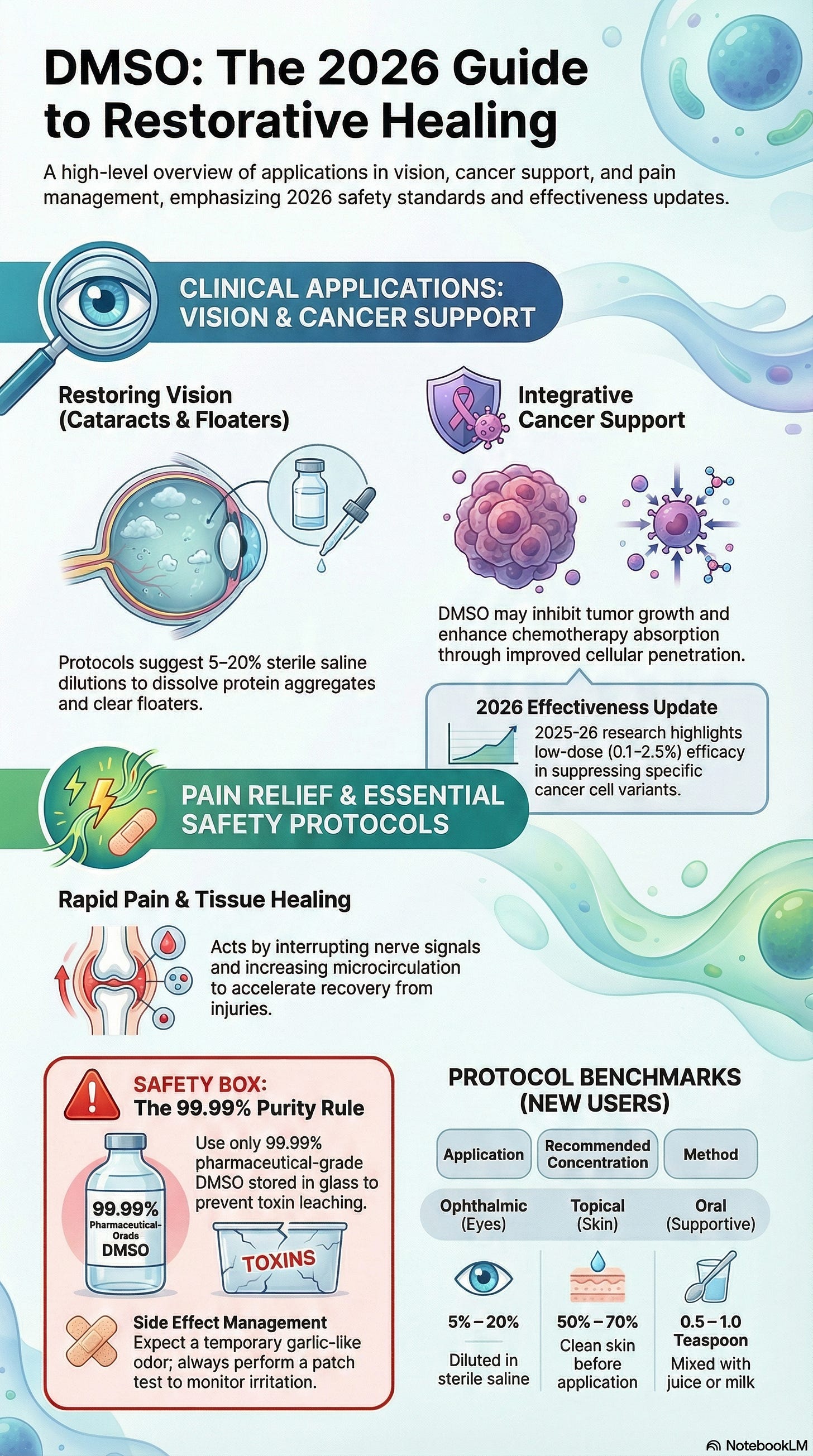
Basic Home Use Protocol for Pain & Musculoskeletal Injury
Important: The following represents general information compiled from published clinical literature. Always consult a qualified healthcare provider before using DMSO. Do not apply DMSO over skin that has had any toxic chemical exposure. DMSO is available as a veterinary/industrial solvent — pharmaceutical-grade DMSO should be used for human application.
|
1
|
Prepare the skin Wash the area thoroughly with soap and water. Dry completely. Do not apply any other product (lotion, medication, perfume) to the area within 30–60 minutes before or after DMSO application. |
|
2
|
Select concentration 50% DMSO — general chronic pain, sensitive skin, first-time use. 70% DMSO — arthritis, musculoskeletal injuries, standard clinical use. 90–99% DMSO — acute injuries, under clinical guidance only. Begin at lower concentrations and increase based on skin tolerance. |
|
3
|
Apply to affected area Apply with a glass rod, cotton ball, or clean fingertips (DMSO will penetrate through gloves — use bare clean hands or ensure gloves are DMSO-resistant). Cover as broad an area as practical around the pain site. Rub gently — it absorbs rapidly. |
|
4
|
Frequency Acute pain/injury: Every 2–3 hours for the first 24–48 hours, then reduce to 2–3x daily. Chronic pain: 2–3x daily for at least 4–7 days before expecting significant improvement; 6–8 weeks for lasting relief. |
|
5
|
Expect and monitor A garlic-like taste/odour is normal and expected within minutes — this confirms absorption. Mild skin redness/warmth at the application site is normal. Discontinue if severe skin reaction develops. The pain-relief effects typically appear within 30–90 minutes of first application for acute conditions. |
Frequently Asked Questions
What is DMSO and how does it relieve pain?
DMSO (Dimethyl Sulfoxide) is a naturally occurring organosulfur compound with four simultaneous analgesic mechanisms: selective C-fiber and Aδ nerve conduction blockade, powerful anti-inflammatory action, skeletal muscle relaxation, and restoration of blood flow to ischemic tissue. Its analgesic potency is comparable to morphine in preclinical studies — but without opioid receptor binding, addiction risk, or significant toxicity.
What types of pain does DMSO treat?
DMSO treats a wide spectrum of pain disorders: joint/arthritis pain (osteoarthritis, rheumatoid arthritis, gout), neuropathic pain (CRPS, trigeminal neuralgia, small fiber neuropathy, phantom limb pain), musculoskeletal pain (back pain, neck strain, sprains, tendinitis, bursitis, restless leg syndrome), headaches (tension, cervicogenic, sinus, temporal arteritis), fibromyalgia, cancer pain, and post-surgical pain.
Is DMSO safer than NSAIDs (ibuprofen) for pain?
Yes — by a significant margin. NSAIDs kill tens of thousands of people per year and are the leading cause of drug-induced hospital admissions due to gastrointestinal bleeding, renal failure, and cardiovascular events. DMSO has not been linked to a single death in over 60 years of use. A systematic review of all published DMSO studies found its side effects — transient skin irritation and a temporary garlic-like odour — to be minor and short-lived. Even at 3–30 times the standard dose over 90 days, DMSO produced no toxicity.
Can DMSO treat complex regional pain syndrome (CRPS)?
Yes — and it is one of the few therapies with documented success in CRPS. The Netherlands has formally included topical 50% DMSO cream in clinical guidelines for CRPS management. DMSO addresses multiple CRPS mechanisms simultaneously: NMDA receptor suppression (blocking central sensitisation), C-fiber blockade, sympathetic nervous system inhibition, free radical scavenging (CRPS has high oxidative stress), and restoration of blood flow to the affected limb.
Why is DMSO not widely used if it is so effective?
DMSO's broad efficacy across so many conditions means it would displace multiple expensive pharmaceutical categories if adopted as a standard of care. Despite congressional hearings in 1980 that grilled the FDA on its embargo, and despite a DMSO champion (Dr. Otis Bowen) becoming Secretary of Health and Human Services in 1985, the FDA's effective prohibition on DMSO remained. DMSO is inexpensive, unpatentable as a natural compound, and therefore offers no commercial incentive for pharmaceutical companies to invest in the approval process.
What are the precautions for using DMSO?
The most important precaution is never to apply DMSO to skin that has been exposed to any toxic substance (pesticides, nicotine patches, mercury, other medications), as DMSO will rapidly carry these into the body. Always clean and dry the skin thoroughly before application. Avoid use during pregnancy until further data is available. Use pharmaceutical-grade DMSO for human application. Consult a qualified healthcare provider before starting DMSO therapy, especially if you are on other medications.
How long does it take for DMSO to work for chronic pain?
For acute pain and injuries, DMSO typically produces noticeable relief within 30–90 minutes of the first application. For chronic pain conditions, meaningful improvement often begins after 4–7 days of regular application, with lasting relief typically achieved after 6–8 weeks of consistent use. Unlike opioids — where tolerance requires ever-increasing doses — DMSO typically becomes more effective over time, and many patients find they need it less and less frequently as the underlying condition resolves.
ONEDAYMD.COM
Integrative Medicine | Metabolic Oncology | Longevity & Wellness
This article is an editorial review compiled from published peer-reviewed literature and clinical case series. It does not constitute medical advice. Source article: A Midwestern Doctor, "DMSO is a Miraculous Therapy for Chronic Pain and Musculoskeletal Injuries," Substack, September 30, 2024 (paywalled). Reviewed and updated by OneDayMD, June 2026.
Disclaimer: This content is for educational and informational purposes only and does not constitute medical advice. Always consult a qualified healthcare professional regarding treatment protocols, dosing, and the appropriate sourcing of DMSO.
Sources and Further Reading
Primary Source for This Review
- A Midwestern Doctor - DMSO is a Miraculous Therapy for Chronic Pain and Musculoskeletal Injuries (September 2024)

.png)


Comments
Post a Comment